Where to Live in Thailand: The Best Cities and Areas for Russians
Where to live in Thailand depends on the task: for a family with children and life by the sea people most often choose Phuket, for a budget winter stay Pattaya, for work Bangkok, for a calm pace Samui and Hua Hin. Below is a comparison of cities, areas, prices in baht and tips on finances when you move.
Thailand is chosen for the long term because of its climate, prices and service, but there is no "best" city for everyone: each has its own character and its own areas — quiet and noisy, tourist and business. Comfortable living depends on the area as much as on the resort. The prices below are taken from the crowdsourced database Numbeo; they are guides, not official tariffs.
Quick comparison of cities
| City | Rent of a 1-bedroom apartment (outside centre / in centre), THB per month | Russian-speaking environment | Pros | Cons | Who it suits |
|---|---|---|---|---|---|
| Phuket | 16,845 / 24,273 | Developed | Sea, beaches, international schools | Expensive rent, seasonal prices | Families, life by the sea |
| Pattaya | 10,053 / 18,428 | Developed | Affordable rent, infrastructure | Noisy areas, nightlife | Winter stay, budget living |
| Bangkok | 11,748 / 23,731 | Present, but scattered | Work, transport, healthcare | Traffic, heat, density | Work, business |
| Samui | 13,000 / 24,436 | Small | Calm island atmosphere | Less infrastructure | Quiet life by the sea |
| Hua Hin | 12,600 / 15,889 | Small | Quiet, close to Bangkok | Fewer entertainment options | Families, retirees |
| Chiang Mai | 10,643 / 16,508 | Small | Cheap living, coworking spaces | Seasonal air pollution | Remote work |
Price source: Numbeo — data for Phuket, Bangkok and Chiang Mai were updated on 26 October 2026, for Hua Hin on 3 January 2026; the Pattaya and Samui pages show no update date. The assessment of the Russian-speaking environment is qualitative and approximate: there are no official statistics.
The best cities in Thailand for Russians to live in
Phuket — for life by the sea and families with children
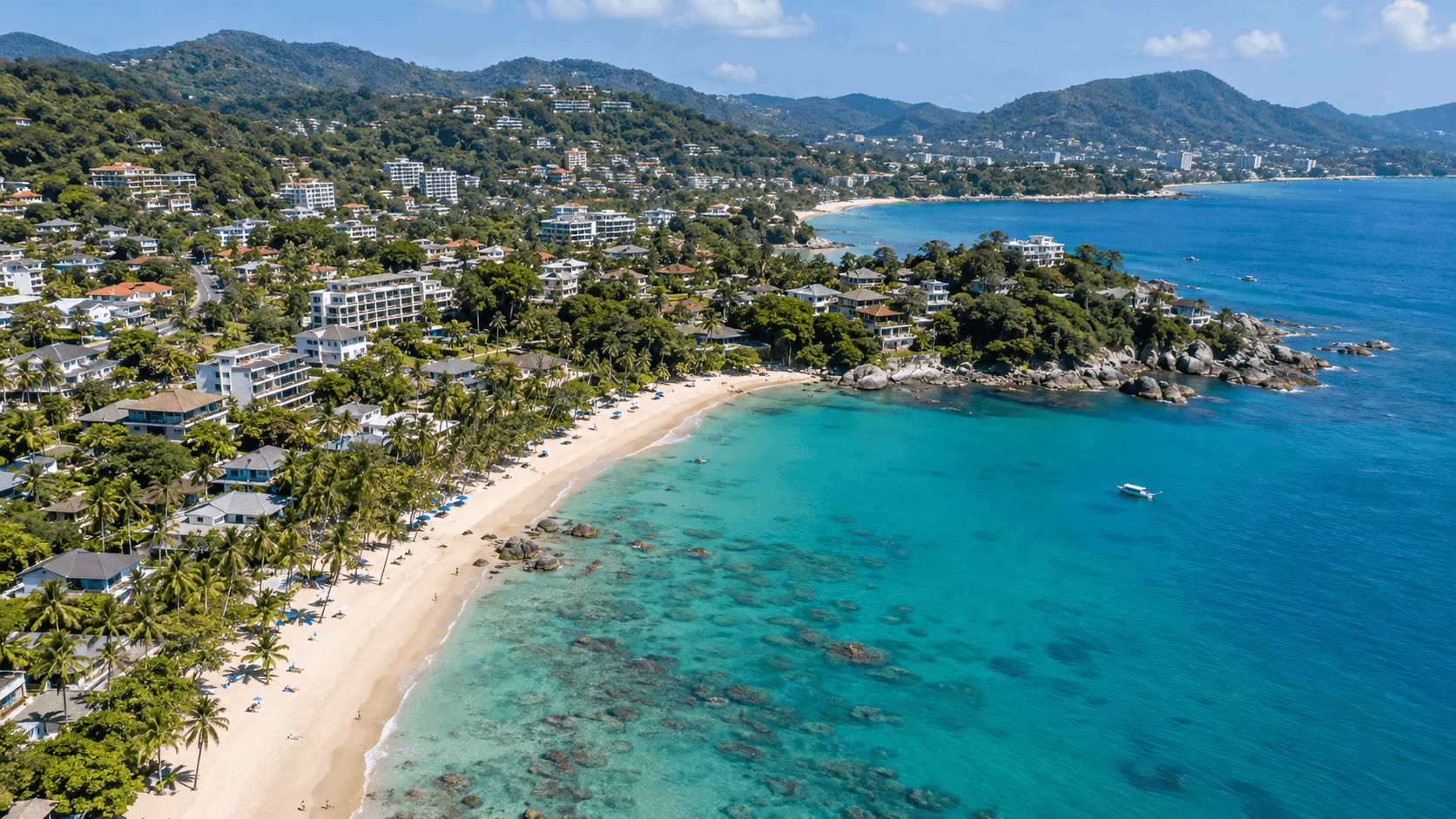
Popular areas of Phuket: Bang Tao, Rawai, Kata, Karon, Patong, Nai Harn. Bang Tao, Kata, Karon and Patong are on the west coast of Phuket, the other areas are in the south. Bang Tao attracts with a long beach and nearby international schools, Rawai is valued for its calm atmosphere and yachts, Kata and Karon are chosen for ready infrastructure for holidaymakers with children, and Patong by lovers of active nightlife. Housing near Kata beach is usually more expensive than away from the sea. These areas differ noticeably in price and noise.
Costs. According to Numbeo (26 Oct 2026), a one-bedroom apartment outside the centre costs about THB 16,845 per month, a lunch in an inexpensive café about THB 150, and the estimated monthly costs of one person without rent about THB 23,060.
Environment and infrastructure. A Russian-speaking community has long existed on the island, international schools and kindergartens operate, and in the holiday season housing prices rise. Phuket's beaches are more varied than on other islands.
Pros: the sea, beaches, developed infrastructure. Cons: expensive rent and traffic jams on Phuket's roads in the high season.
Pattaya — for budget living and winter stays
Popular areas: Jomtien, Pratumnak, Naklua, central Pattaya. These areas are different: Jomtien suits calm evenings by the sea, Pratumnak suits quiet on a hill, Naklua suits families with children, and the centre suits those who value proximity to shops and restaurants.
Costs. A one-bedroom apartment outside the centre is, according to Numbeo, about THB 10,053 per month, an inexpensive lunch about THB 100 (the page has no update date, prices are indicative).
Environment. The city is well provided with infrastructure: shops, doctors, schools, Russian-speaking services. Housing can be rented here at affordable prices.
Pros: affordable prices, many housing options. Cons: noisy areas and a mixed reputation of some streets.
Bangkok — for work, business and city life
Popular areas: Sukhumvit, On Nut, Thong Lo, Silom. Sukhumvit and Thong Lo are the centre with cafés and shopping malls, On Nut has cheaper areas along the metro line, Silom is the city's business areas.
Costs. A one-bedroom apartment outside the centre is about THB 11,748, in the centre about THB 23,731; the estimated costs of one person without rent are about THB 23,498 (Numbeo, 26 Oct 2026).
Infrastructure. The city is provided with transport infrastructure: metro and elevated railway, top clinics, business centres.
Pros: work, transport, healthcare. Cons: traffic jams, heat, high density.
Samui — for a calm island life
Popular areas: Bophut, Maenam, Lamai, Chaweng. Bophut and Maenam are quiet northern areas, Lamai and Chaweng are tourist zones with beaches and bars. The island suits calm holidays and an unhurried routine.
Costs. A one-bedroom apartment outside the centre is about THB 13,000, an inexpensive lunch about THB 100 (no date on the page).
Transport and infrastructure. People get around mostly by motorbike or taxi: public transport is limited. The island is provided with basic infrastructure, but the choice is smaller than in Phuket.
Pros: a calm rhythm and nature. Cons: less infrastructure than in Phuket.
Hua Hin — for families and calm living
Areas for long-term rental are along the beach and closer to the city centre; check the exact neighbourhoods with local agents before signing a contract. A one-bedroom apartment outside the centre, according to Numbeo (3 January 2026), is about THB 12,600.
Infrastructure. The city is provided with medical infrastructure: there are private clinics and shopping malls, and families and retirees value its closeness to Bangkok.
Pros: quiet and space. Cons: fewer entertainment options and jobs.
Chiang Mai — for remote work and affordable living
Popular areas: Nimman, the Old City, Santitham. Nimman has cafés and coworking spaces, the Old City has temples and atmosphere, Santitham has cheaper residential neighbourhoods.
Costs. A one-bedroom apartment outside the centre is about THB 10,643, the estimated costs of one person without rent about THB 18,087 (Numbeo, 26 Oct 2026).
Infrastructure. The city is provided with infrastructure for remote work: coworking spaces and cafés with fast internet.
An important drawback. In the field-burning season the air is full of smoke: check the air-quality forecast before choosing a move date.
Where is the cheapest place to settle: cost of living by city
Cities and areas with affordable rent
According to Numbeo, the lowest rent for a one-bedroom apartment outside the centre is in Pattaya (about THB 10,053) and Chiang Mai (about THB 10,643). Next come Bangkok (about THB 11,748) and Hua Hin (about THB 12,600). On Samui and in most areas of Phuket rent is higher. You can also find an apartment at affordable prices if you choose an area away from the beach.
How much food, transport and utilities cost
An inexpensive lunch costs THB 75–150, utilities about THB 2,100–3,600, and internet about THB 520–750. Transport depends on the city: Bangkok has a metro and an elevated railway, while elsewhere you more often need a motorbike or a taxi.
Where it is more economical to live alone, as a couple or as a family
Alone it is easier in Chiang Mai and Pattaya, as a couple in Bangkok or Hua Hin, while families will have to budget for school and a larger apartment.
Monthly costs by city (THB)
| City | 1-bedroom rent outside centre | Utilities | Internet | Inexpensive lunch | Costs without rent (1 person) |
|---|---|---|---|---|---|
| Phuket | 16,845 | 3,300 | 577 | 150 | 23,060 |
| Bangkok | 11,748 | 3,636 | 611 | 100 | 23,498 |
| Chiang Mai | 10,643 | 2,095 | 674 | 75 | 18,087 |
| Pattaya | 10,053 | 2,375 | 612 | 100 | no data |
| Hua Hin | 12,600 | no data | 749 | 100 | no data |
| Samui | 13,000 | no data | 520 | 100 | no data |
Data: Numbeo; Phuket, Bangkok, Chiang Mai — 26 October 2026, Hua Hin — 3 January 2026, Pattaya and Samui — no date given. A guide to rent plus one person's costs: Phuket about THB 39,900, Bangkok about THB 35,200, Chiang Mai about THB 28,700. This is an arithmetic sum of Numbeo data, not a forecast.
Which city to choose depending on your purpose
For families with children
Families are most often suited to Phuket and Bangkok: there are more international schools and clinics. According to Numbeo, a private kindergarten in Phuket costs about THB 15,900 per month and an international primary school about THB 385,600 per year; in Bangkok about THB 26,900 and THB 564,500 respectively. More about kindergartens is below.
For retirees
Retirees choose Hua Hin, Pattaya and Chiang Mai: calmer, cheaper and with healthcare nearby. Check visa conditions and insurance in advance.
For remote work and digital nomads
Chiang Mai and Bangkok are best suited to remote work: coworking spaces, fast internet and a community.
For a 2–3 month winter stay
Pattaya and Phuket suit a winter stay: you can rent housing for a short term. Details are in the article how to rent accommodation in Thailand.
For permanent residence
Here infrastructure matters more: schools, hospitals, work. Bangkok and Phuket are often chosen. If you are considering buying, assess the rental yield: what buying property gives you.
For living near the sea
If you need proximity to the sea, look at Phuket, Pattaya, Samui and Hua Hin. Beaches differ: Phuket has more choice, Samui is quieter.
Which areas of Thailand to choose for long-term rental
What to pay attention to when choosing an area
Look at the distance to the sea, shops and stops, evening noise and flooding in the rainy season. Visit the area of your chosen city at different times of day. Compare areas, not only resorts:
- Quiet areas suit families and retirees.
- Noisy areas with bars are chosen by those who look for nightlife.
- Business areas are convenient for people working in an office.
- Inexpensive areas are usually farther from the sea and the metro.
How to choose housing near schools, hospitals and transport
Make a map: school, clinic, the nearest supermarket and a stop. It is better to choose housing where all this is reachable within 10–15 minutes.
Where to look for an apartment or a house to rent
Long-term rental is usually better value than daily rental. Search through local agencies, messenger groups and classified sites. Do not transfer a deposit before viewing the housing and signing the contract.
What costs to consider besides rent
Besides rent, include the deposit, utilities, internet, transport and upkeep of the pool or residential complex. More in the rental guide.
Pros and cons of living in Thailand for Russians
Climate, infrastructure and quality of life
A warm climate and a developed service sector make life comfortable, but heat and humidity take getting used to.
Language barrier and cultural features
Outside tourist areas not everyone knows English, and cultural norms (respect for the royal family and temples) must be observed.
Seasonality, heat and the rainy season
The high season is more expensive, and flooding is possible in the rainy season. More in the article the best time to visit Thailand.
Safety and healthcare
Private clinics in big cities are of a good level, but treatment is paid, so insurance is needed.
What to know before moving to Thailand
Visas and grounds for long-term stay
Russians are allowed to stay in the country without a visa for a limited period:
A long stay needs a suitable visa or program: conditions change, so check the thailand.go.th portal and the embassy website.
Health insurance and access to medicine
Choose a policy that covers hospitalisation. Find out in advance which clinics are near your area.
Kindergartens and international schools
Cities with a large foreign community have international schools and kindergartens; costs are shown above. Choose a school before renting housing: it is easier to pick an area that way.
Work and restrictions for foreigners
Foreigners need a permit to work. Do not work on a tourist status: details are available from the official Thai authorities [CONFIRM: link to an official source on work permits].
How to organise finances when moving to Thailand
Which currency to bring
US dollars and euros are usually exchanged more readily than rubles; bringing in large amounts must be declared. More in the article what to pack for Thailand.
How to exchange rubles for Thai baht
Rubles can be exchanged for baht through a licensed service: EXFM operates under Bank of Thailand licence No. MC225670007. Calculate an exchange of rubles to baht in advance.
Which Russian bank cards work in Thailand
Visa and Mastercard cards issued by Russian banks, as a rule, do not work abroad. A breakdown is in the article which cards work in Thailand.
How to receive money from Russia during a long stay
For regular receipts you need a clear channel: a transfer or an exchange through a licensed operator. Transfer terms should be clarified with an EXFM manager [CONFIRM: link to the transfers page].
Frequently asked questions
Which city in Thailand is best for Russians to live in?
It depends on the goal: Phuket and Pattaya for a developed Russian-speaking environment, Bangkok for work, Chiang Mai for remote work.
Where in Thailand is the cheapest place to live?
According to Numbeo, rent is lowest in Pattaya and Chiang Mai.
How much money do you need per month to live in Thailand?
By Numbeo's estimate, one person without housing spends about THB 18,000–23,500 per month in Chiang Mai, Phuket and Bangkok; rent must be added.
Where is it better to live with children — Phuket or Pattaya?
Phuket's international schools and its family areas are more convenient for children, Pattaya is cheaper; decide by school, budget and lifestyle.
Where are there the most Russians in Thailand?
Russian-speaking communities are noticeable in Phuket and Pattaya; there are no exact statistics.
Can you live permanently in the country without citizenship?
Permanent residence without citizenship is possible with a suitable visa or program; check the conditions with the official authorities.
Which city in Thailand is best for a winter stay?
For a winter stay people most often choose Pattaya, Phuket and Hua Hin.
Where is it best for retirees to settle?
Retirees are often suited to Hua Hin, Pattaya and Chiang Mai.
Conclusion
For an economical option look at Pattaya and Chiang Mai, for a family with children at Phuket and Bangkok, for work at Bangkok and Chiang Mai, for a winter stay at Pattaya and Phuket, for a quiet holiday by the sea at Samui and Hua Hin. Before the final decision, rent a place for a trial period and prepare your finances in advance: calculate an exchange of rubles to baht or message an EXFM manager.