
How to Rent Accommodation in Thailand in 2026: Prices, Rental Terms and Ways to Pay
How to rent accommodation in Thailand without overpaying: in Phuket, a one-bedroom condo usually costs from 12,000 to 35,000 baht a month, you are asked for a deposit and the first month's rent on move-in, and you cannot pay with a Russian card. Here is where to look, how much it costs, what to put in the lease and how to transfer money to the landlord from Russia.
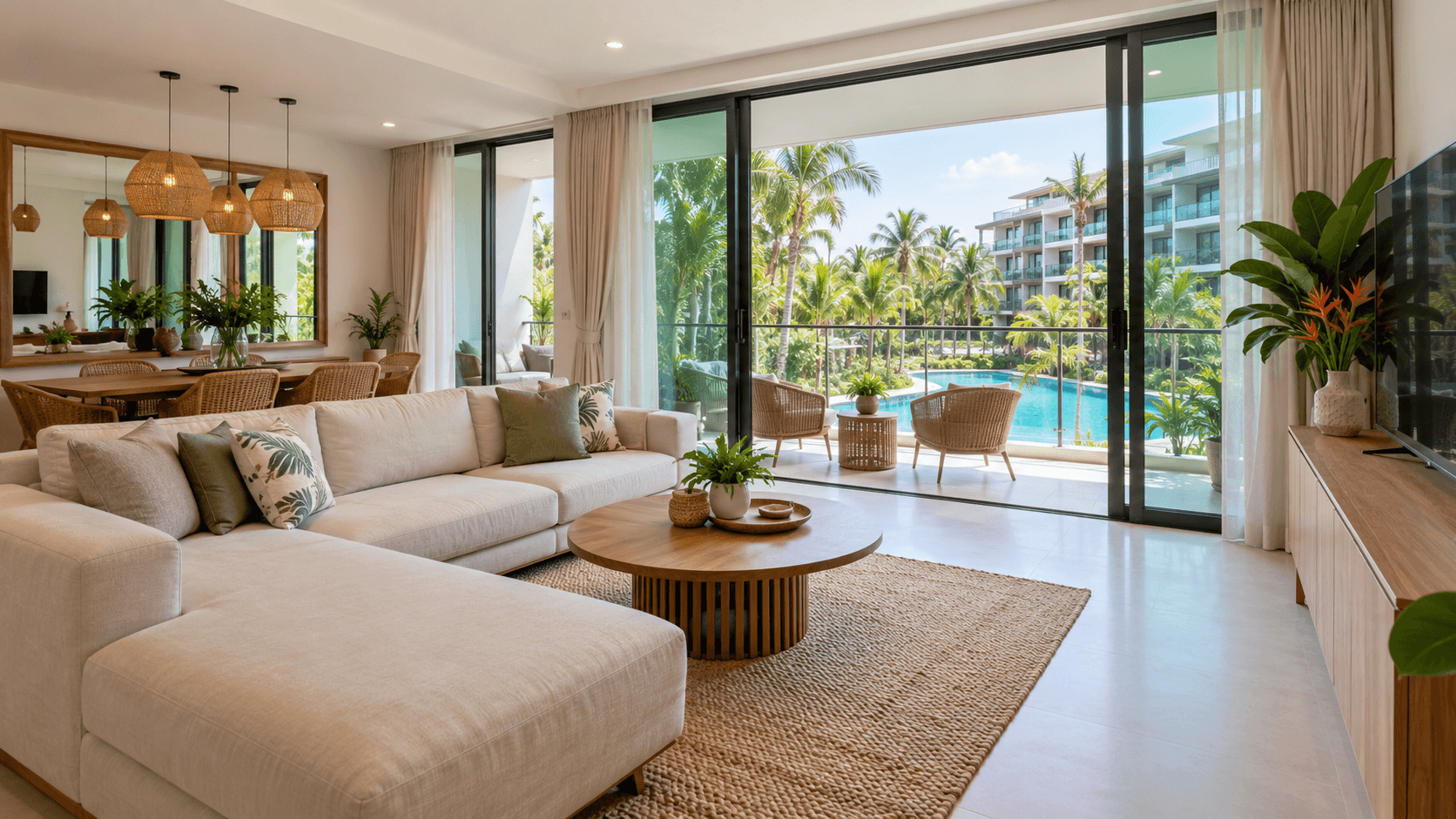
Renting an apartment in Thailand is easier than in most countries: the owner is ready to show the property the same day, and the lease is signed within an hour. The difficulties come later — with the deposit, electricity bills and the need to pay in baht when the cards of Russian banks do not work. This article is for those who are coming for several months or for the season and are choosing between a condo, serviced apartments and a villa. The prices in it are guidelines from 2026 listings and directories, not fixed rates: they depend heavily on the area, the floor and the move-in date.
What kind of accommodation can you rent in Thailand
A foreigner can rent any type of accommodation: there are no restrictions like those on buying land or the foreign quota for condominiums. The choice is determined by your budget, the length of your stay and whether you need the infrastructure of a complex.
Apartments and condominiums
An apartment in a condominium is the most common option. Usually it is a studio or one or two bedrooms with furniture and appliances, and the complex has a pool, a gym and security. For one or two people for a period of three months or more, this is the best balance of price and convenience.
Serviced apartments and hotel residences
Serviced apartments are closer to a hotel: cleaning, a front desk, and sometimes utilities included in the price. They cost more than condominiums but suit a period of a few weeks, when you do not want to bother with bills.
Private houses and villas
A house or villa with a pool is an option for a family or a group. The price depends on the area and the season, and electricity bills (air conditioners and a pool noticeably increase consumption) and garden and pool maintenance are added to the rent. What to look at in the lease is covered in detail in the article about renting villas in Phuket.
Where to look for accommodation to rent
Online property platforms
The main platforms are Thai catalogs such as DDproperty, Hipflat, Dotproperty and FazWaz, as well as Telegram and Facebook groups by area. A catalog shows the "listing price", which is usually higher than the price at which the parties sign the lease, so negotiating is appropriate.
Renting directly from the owner
Renting directly is usually cheaper: there is no agency commission. In return, you check the ownership and the lease yourself. Ask for a copy of the owner's passport and the title document for the property (chanote) or a power of attorney for the manager.
Renting through agencies and realtors
An agency takes care of the search and viewings, but the size of the commission and who pays it is determined individually — in the sources we found there is no single standard. Record the terms in writing before viewings.
Looking for accommodation after arriving in Thailand
It is more reliable to choose in person rather than from photos: first live for a week or two in a hotel or serviced apartment, view several options and only then sign the lease. This is convenient, but the visa-free stay is limited (more in the section on the lease), so do not delay the search.

How much does it cost to rent accommodation in Thailand in 2026
The prices below are guidelines from 2026 directories and listings. Data from different sources differ, so check current offers in the area you need.
Rental prices in Phuket
Phuket housing is the most expensive among Thailand's resort regions, and the spread within the island is huge. A one-bedroom apartment in Phuket Town costs many times less than the same one in Bang Tao or Laguna, but the beach is farther from it. New complexes of 2026 are more expensive: one property in Thalang was rented for 35,000 baht a month.
Housing prices in Pattaya and Bangkok
Pattaya is cheaper than Phuket: in the center a one-bedroom apartment usually costs 12,000–25,000 baht, but according to August 2026 listings the median for the center is about 28,000 baht, for Jomtien 26,000 and for Wongamat 32,500. Keep in mind that these are listing prices, not signed leases. In Bangkok a one-bedroom near a BTS station costs about 18,000–35,000 baht, and in areas farther from the metro there are offers below 10,000.
Renting property in Samui and other regions
Samui has less choice, and prices are comparable to Phuket. For example, in one listing an apartment in Lamai costs 51,150 baht a month on an annual lease and 55,000 for a rental of 3–6 months, and a house with a garden in Taling Ngam costs 30,000. These are individual properties, not average prices.
How seasonality affects rental prices
The high tourist season coincides with the cool season, so rental prices in these months are usually higher. In the high season (November to February) owners raise prices and are reluctant to give way, while in the rainy season they are, on the contrary, open to bargaining. If you are coming for several months, it is more advantageous to move in at the start of the low season and fix the price for the entire lease period — this way you avoid a rise for the Christmas holidays.
Short-term and long-term rental: which is better
A long-term lease (six months or more) is cheaper per month but ties you with a penalty for leaving early. Short-term rental for one to three months is more expensive and more often requires payment in advance. The difference in one Samui listing is about 4,000 baht a month in favor of the annual lease.
Additional costs when renting property
Security deposit and prepayment
The market standard is a deposit of two months plus the first month's rent in advance: for a one-bedroom apartment at 20,000 baht you need to prepare about 60,000 baht on move-in. Premium properties ask for three months. A deposit is not an extra charge but a guarantee against damage and unpaid bills.
Move-in requires a large sum in baht at once: the deposit plus the first month. So you do not have to look for cash on move-in day, calculate the exchange in advance: the EXFM calculator shows a guideline, and the manager confirms the rate before the transfer and offers a convenient way to receive it — an office, a courier or a transfer to the owner's account.
Real estate agency commissions
If you work through an agency, clarify before viewings who pays the commission and in what amount. Its size is not regulated by a single tariff.
Utilities: electricity, water and internet
Electricity is the most noticeable item. The government tariff for households in 2026 is approximately 3.9–4.4 baht per unit, but condominium management companies and villa owners often charge 6–9 baht. Water and internet add about 1,500–5,000 baht a month depending on the area and consumption. Put a fixed tariff per unit in the lease, not the wording "at the management company's discretion".
Cleaning, maintenance and other hidden charges
For villas — pool and garden care; for condominiums — sometimes a service fee and parking. Ask the owner what is included in the rent and write it into the lease.
How can Russians pay rent in Thailand
Paying in cash in Thai baht
Many owners take the deposit and the first payment in cash, especially private landlords. Take a receipt or a signature in the lease: cash without documents is a frequent cause of disputes. If you need to collect the required amount in baht quickly, baht can be received at an EXFM office or by courier — the rate is confirmed before the exchange.
Transfer to the landlord's bank account in Thailand
Large landlords and management companies accept transfers to a bank account. Write the details — account number, bank branch and the owner's name — directly into the lease. The recipient's name must match the owner or management company in the lease.
So if there is little time left before move-in, do not count on a "same-day" transfer: allow for the timing or choose payment in cash.
Paying with a foreign bank card
A card from a foreign bank suits online bookings and rentals through platforms, but small owners often accept only baht or a transfer. More in the article on which cards work in Thailand.
Can you pay rent with a Russian bank card
No: Visa, Mastercard and Mir cards of Russian banks are not accepted in Thailand, and UnionPay from two banks is accepted unreliably, especially by private owners.
For Mir, the obstacle is US sanctions against the system's operator, NSPK (OFAC, 23 February 2024).
Can you use cryptocurrency to pay rent
Direct payment with digital assets is not accepted in Thailand: the property owner receives baht. A working route is to exchange USDT for baht through a licensed service.
How to transfer money from Russia to pay rent in Thailand
Which transfer methods are available to Russians
Realistic options: currency exchange and cash baht, a transfer to a foreign bank account followed by payment, or payment through an exchange service that transfers the money to the landlord in Thailand. A direct transfer from a Russian bank to a Thai account does not always go through.
How to exchange rubles for Thai baht
Rubles are not accepted everywhere in Thailand, so it is more convenient to exchange them through a service with a Bank of Thailand license. EXFM converts rubles to baht at a rate the manager confirms before the transfer, and for exchanges from 49,999 THB the rate becomes more favorable. You can calculate the amount on the ruble-to-baht exchange page.
Fees, exchange rate and crediting times
The fee is built into the rate and fixed before the transfer — there are no hidden charges. The time depends on the way you receive it: cash at an office or by courier is agreed by the manager in advance, and a bank transfer follows the schedule of your bank and the recipient's bank.
How to safely transfer a large sum for a long-term rental
Do not send a large prepayment before viewing the property and signing the lease. Pay by non-cash transfer and keep the receipt, and if you need cash for the deposit, get it by request through an office or courier. EXFM can pay the rent or deposit for you: you transfer rubles or online dollars to the company, and it converts them into baht and passes them to the landlord — by transfer to an account or in cash through an office or courier. Details are in the article on paying for property or rent.
How to sign a property lease in Thailand
Which documents a foreign tenant needs
A passport, an entry record (a stamp or the TDAC electronic card) and contact details. For a villa or a long rental, the landlord may ask for a copy of a document confirming your right to stay.
What to check in the lease before signing
Housing rental in Thailand has been under special control since 2025: on 30 May 2025 the Contract Committee under the Office of the Consumer Protection Board (OCPB) issued an announcement under which renting housing for residence became a "business with contract control". This means the lease must be drawn up in standard forms, and the OCPB has published samples — for example, form "A" for short-term rental.
Which landlords and properties the rules apply to depends on the text of the announcement, so check it for your case; in any case the minimum to verify is: the parties and the document giving the right to rent out the property, the length of the lease, the amount and procedure for returning the deposit, the electricity and water tariffs, and the termination terms.
How to fix the rent amount and the payment currency
State the amount in baht and that it does not change for the whole rental period. If the rent is tied to the dollar, specify the conversion rate. Record on which day of the month and by what method to pay, so you do not get a fine for "late payment".
How to document the transfer of the deposit and prepayment
The deposit and the first month's rent are handed over with written confirmation: a receipt, a signature in the lease or a transfer receipt. Photograph the receipt and keep the correspondence.
Terms of renewal and early termination of the lease
Clarify the notice period for moving out and the renewal terms. A property lease for more than three years must be registered with the Land Department, otherwise it is protected for only three years. The maximum is thirty years:
For a standard rental of up to a year this does not matter, but if an owner offers a "30-year lease" instead of a purchase, move on to the breakdown of Leasehold and Freehold ownership.
How the length of the lease relates to your visa
Since 15 September 2026, Russians may stay in Thailand without a visa for up to 30 days, while for entries before this date the previous 60-day limit applies. This is reported by the Thai Embassy in Moscow:
Check the terms and cost of an extension with the immigration office. If you are renting an apartment for several months, include an extension or a long-term visa in your plan: for example, the DTV visa for remote workers is issued for five years with a stay of up to 180 days per trip. Match the length of the lease with the actual period of your right to stay in the country.
TM30 notification
The landlord is obliged to notify the immigration service that a foreigner has moved into the rented property within 24 hours — this is set out in Section 38 of the Immigration Act:
Once you have rented an apartment, ask the owner right away to file the TM30 and keep the confirmation: it may be needed when extending your visa.
How to get your deposit back after the lease ends
Under what conditions the deposit is returned
The deposit is returned if the property is handed back in the same condition, the bills are paid and the move-out is arranged under the lease. A refund is most often scheduled 30 days after the keys are handed over, but 45 and 60 are also seen. If the date is not specified, go by 30 days.
What the landlord may deduct money for
For damage beyond normal wear, unpaid electricity, water and internet bills, and for breach of the lease terms. Any deduction must come with a receipt or an invoice. Vague wording such as "any damage at the owner's discretion" is better replaced with a list of permitted deductions.
What to do if the owner refuses to return the deposit
Write a written demand referring to the clause of the lease and attach photos from move-in and move-out. If the lease falls under the rules on controlled rental contracts, you can file a complaint with the Office of the Consumer Protection Board of Thailand (OCPB) or go to a lawyer and the court. Reports on the maximum deposit amount and the time of its return differ between sources, so check the terms in the text of the lease.
How to rent accommodation in Thailand on your own: step-by-step guide
Choose a region and calculate a budget
Decide on the area, the length and the type of accommodation. Include in the budget the rent, the deposit, two months of electricity and the money exchange. If you plan to live on the island for several months, add the cost of a visa extension.
Find and check suitable properties
Shortlist three to five options and view them in person or by video call. Check the noise, the water pressure, the internet and the condition of the air conditioners — they are what most often produce extra bills.
Agree on the price, deposit and payment terms
Bargain on duration: the longer the lease, the bigger the discount. Discuss the deposit, the return date and the electricity tariff — all of this is settled before signing.
Inspect the property and sign the lease
Draw up an inspection report, photograph the rooms and appliances, and check the owner's details. Ask for a bilingual version of the lease if the main language is Thai.
Pay the rent and receive the keys
Pay by non-cash transfer or in cash with a receipt, receive the keys and keep the confirmations. Ask the owner to file the TM30. If you need to pay in baht and rubles remain on your accounts, contact EXFM: the service will pay the rent and deposit on your behalf and pass the money to the owner by transfer or in cash.
How to avoid fraud and financial losses when renting
How to check the owner or the agency
Ask for a document giving the right to rent out the property: a chanote or a power of attorney, and the owner's passport. If you work with an agent, request written confirmation of their authority. Make sure the payment recipient's name matches the owner.
Why it is dangerous to transfer a prepayment without checking the property
The classic scheme is beautiful photos, an "urgent" request to transfer a reservation and a vanished "owner". Do not transfer money for a property you have not seen in person or on a video call from inside the apartment, and do not pay bypassing the lease.
How to record the condition of the property and meter readings
On move-in day, film all the rooms and photograph the electricity and water meter readings. Send the files to the owner in a messenger the same day.
Which documents and payment confirmations to keep
The lease, the inspection report, receipts and transfer slips, the correspondence about the deposit and the TM30 confirmation. These documents are the foundation in a dispute over the return of the deposit.
Frequently asked questions about renting accommodation in Thailand
Can I rent an apartment in Thailand without a Thai bank account? Yes. Landlords accept cash baht, and some accept a transfer from a foreign bank. For payments from Russia, an exchange through a licensed service with receiving baht in cash or by transfer to the owner works.
Can I pay rent in rubles? No: rent is expressed in baht. Rubles must be exchanged for baht and then handed to the owner.
How many months of rent are usually paid in advance? The standard is one month's rent for the first period and a two-month deposit. For premium properties a three-month deposit is possible.
Is a deposit mandatory? Almost always yes: it is a guarantee against damage and bills. Its size and return date must be written in the lease.
Can I rent accommodation for one month? Yes, but such offers are more expensive per month, and the deposit may be requested in full. There are many short-term options in serviced apartments and villas.
Can I get my prepayment back if I cancel the booking? It depends on the lease. Check the cancellation terms before paying and keep the confirmations: a receipt or a slip is grounds for a refund.
Who pays the utilities? The tenant, by meter readings and at the tariffs specified in the lease. Check the tariff at which the owner counts electricity: it may be higher than the government one.
Do I need to notify the immigration service of my place of residence? The obligation lies with the property owner: they file the TM30 notification within 24 hours after the foreigner moves in. Ask for the confirmation and keep it.
Conclusion: how to rent accommodation and not overpay
Looking at renting from the other side, people overpay not for the apartment but for mistakes: a deposit without an inspection report, an electricity bill at an inflated tariff, a lease that does not match the visa in time. So the main sums are saved before signing: compare two or three offers, fix the tariffs and the deposit return date in the lease, and make transfers with receipts.
Want to pay rent or a deposit without a Thai card? EXFM will convert rubles to baht and pass the money to the landlord — in cash through an office or courier, or by transfer to an account. Calculate the ruble-to-baht exchange or write to a manager: they will confirm the rate and terms before the transfer.