

Rufat Mamedov
Came to Thailand for 3 months — best rate I found, excellent service, Russian-speaking team, needed cash urgently and they delivered to my door. Thank you!
- 3
- Yandex Maps

Bank of Thailand license MC225670007
Guaranteed transactions and an office network across Thailand
Fast processing — within 5 minutes
No hidden fees — clear and honest exchange rates
Lifetime payouts — clients stay linked to you with no time limit
Full transparency and detailed stats in your partner dashboard
Tracking captures partner ID even for offline ruble exchange at a branch
Verified Telegram channel with financial analytics for work and business in Thailand
Instagram and YouTube about life in Thailand from experienced expats who know how to make tropical living comfortable
Expert articles on finance and buying property in Thailand

Picture this: you hand over a hundred-dollar bill at an exchange counter — and instead of the rate you expected, you're quoted noticeably less than the person ahead of you just got for what looked like an identical note, or you're asked to show a different bill altogether. It's not you, and it's not the particular counter: Thailand treats the age and condition of dollar bills more strictly than almost anywhere else. Here's why, and how to exchange dollars for baht at an EXFM office without losing money on the details.
The US dollar is accepted almost everywhere in Thailand — that's not the issue. The issue is that exchange counters here have historically been cautious about bill series and condition. A torn note, one with pen marks, heavy wear, or a small denomination (1, 2, 5 dollars) will almost always get a worse rate — and a bill from an older print series can be turned away entirely, even if it looks intact. This isn't a quirk of one provider; it's standard practice across Thailand's exchange market, shaped by years of counterfeit and withdrawn dollar notes circulating in the region, which left counters permanently cautious.
The gap shows up exactly at the counter: you expected one number, and you get another, because a bill that spends perfectly fine at home is treated as "risky" here. Knowing this ahead of time is the only way to avoid being caught off guard.
EXFM (Fast Money Exchange) is licensed by the Bank of Thailand under No. MC225670007. USD exchange happens only in person, at one of the offices in the Surin, Karon, or Rawai areas of Phuket, open daily 10:00–22:00.
The process is straightforward: you bring your passport and your bills, a manager checks each note — denomination, series, condition — and confirms the exact baht amount before you agree to anything. If some of your bills fall under a reduced rate, you find out immediately, not after the fact. Cash is handed over on the spot, with no waiting or follow-up visit.
If you're bringing a large sum, or a mix of bills of different ages and condition, it's worth messaging a manager in advance and describing what you have — it saves everyone time once you're there.
This reflects general practice across Thailand's exchange market, not just one provider:
Practical tip: if you're bringing dollars to Thailand specifically to exchange, favor larger bills — 50s and 100s — from newer series where possible. It's not a guarantee, but it meaningfully improves your odds of getting the standard rate without surprises.
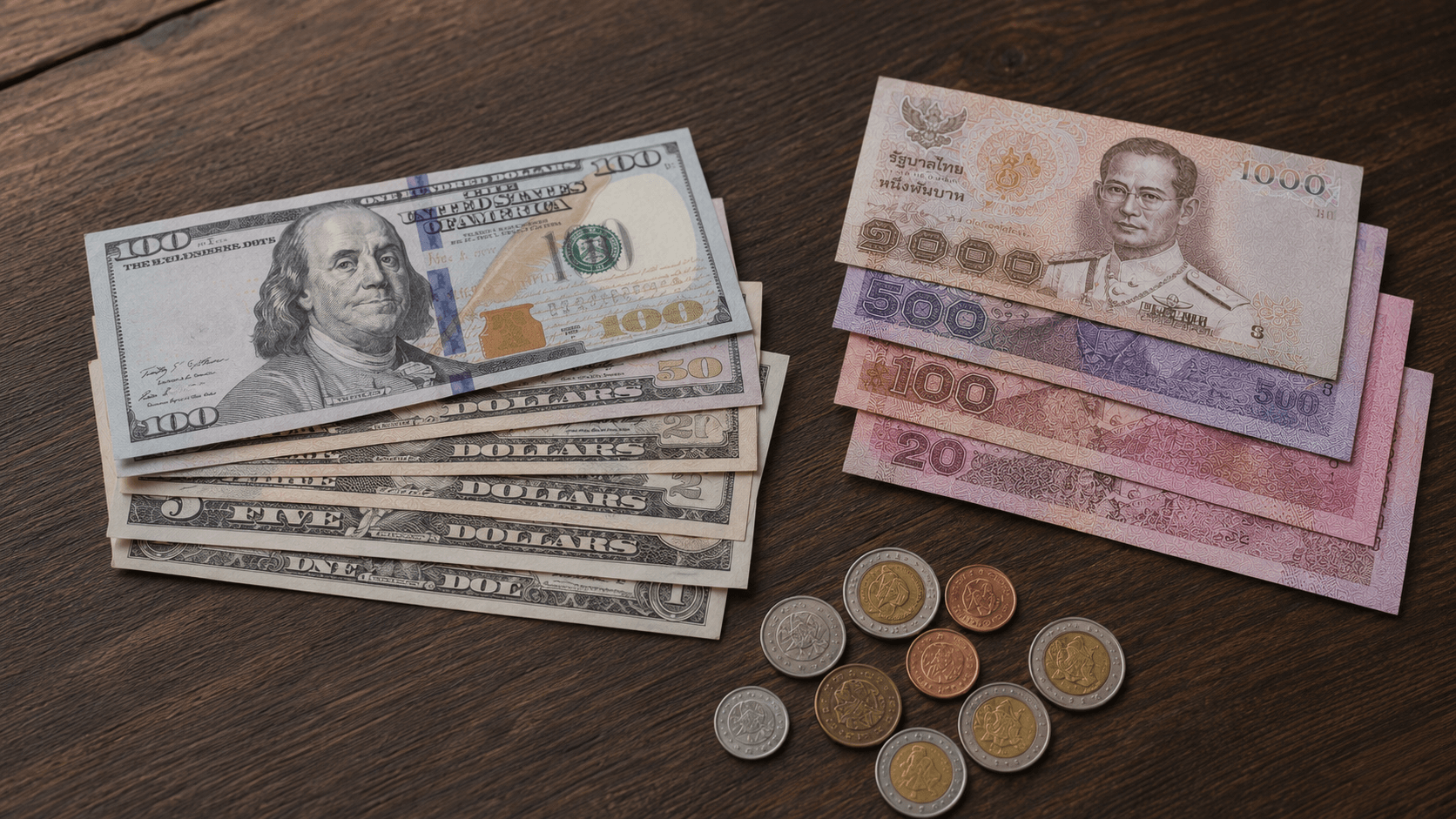
Cash exchange is convenient for everyday spending on a trip, but not for everything:
Service hours: 09:00–00:00 Thailand time (GMT+7)

