
When Is the Best Time to Visit Thailand: Seasons and Weather by Month
When is the best time to go to Thailand, month by month: Phuket, Krabi and Phang Nga are best from November to April, Samui and Phangan from January to September, and Bangkok from November to February. There is no perfect month for the whole country: the Andaman coast and the Gulf of Thailand get their rain at different times.

Thailand welcomes tourists all year round, but in some months the beach in Phuket means turquoise water and calm seas, and in others a red flag and cancelled boat tours. If you choose dates by the general formula "go somewhere warm in winter", you can end up in Samui at the height of the rains or in Phuket at the peak of the monsoon. The main thing to know in advance: the country has two coasts, and the season on them does not coincide, so every month needs to be checked against a specific resort. A beach vacation in Phuket in winter and in Samui in summer are two different scenarios. Below is a breakdown by month, resort and type of vacation, plus when it is cheaper and which holidays change your plans.
The weather figures are guidelines from directories and weather data: in different years the monsoon arrives earlier or later, and it is best to check the weather against the forecast a week before departure.
When is the best time to go to Thailand
The short answer depends on where you are going. If you need one rule and one month to choose, November to February is cool and dry across almost the whole country, and it is the most in-demand period. If you are choosing a specific resort, see the table.
What seasons does Thailand have
By the division of Thailand's national meteorological service, the year has three seasons: hot, rainy and cool. The boundaries are approximate, and they shift by a few weeks from region to region.
The high tourist season
The high season falls in the cool period — roughly from November to February. These are dry days, moderate heat and the maximum number of tourists. At this time accommodation, tickets and excursions are at their most expensive; the peak is the Christmas and New Year holidays, and hotels fill up in advance.
For Russians planning to winter in Thailand, the time limit matters: since 15 September 2026, the visa-free stay has been shortened to 30 days.
So the visa-free period will not cover the whole high season (November to February): plan for an extension or a visa.
The low season and the rainy season
The low season runs from May to October. Thailand's meteorological service announced the start of the rainy season in 2026 from 15 May. Rain most often comes in downpours during the day rather than all day long, so a trip at this time is quite realistic, especially if you are not tied to the beach.
The hot season
The hot period is March and April, before the rains begin. In Bangkok the daytime temperature can reach 36 °C, and at night it does not drop below 27 °C. This is not the best time for city excursions, but by the sea it is tolerable.
Why the weather differs on the Andaman coast and in the Gulf of Thailand
The Andaman coast (Phuket, Krabi, Phang Nga) is open to the southwest monsoon from the Indian Ocean and receives it from May to October. The Gulf of Thailand (Samui, Phangan, Tao) is sheltered from it, so it is drier there in summer, and the main rains come later — from October to December, with the northeast monsoon. That is why the same month in Phuket and Samui can be both the best and the worst. The vacation season in Phuket and in Samui differs by almost half a year.
Weather in Thailand by month
Weather by month: January – December
The table is a summary from directories and weather sites, not exact meteorological data: in a particular year the picture differs.
The most ambiguous month is January in Samui: the sources disagree — at the start of January rain still occurs on the island, and by February it becomes noticeably drier.
When is the best time to visit Thailand's resorts
The season in Phuket
The best time is from November to April: it is sunny, the sea is calm and boat tours run. From May to October, rain falls on the island's west coast and heavy swell occurs, and swimming at open beaches on such days is dangerous. If you need an option for the "shoulders" of the season, look at the end of October, November or April.
When to go to Pattaya
Pattaya is located in the Gulf of Thailand and closest to Bangkok, so the conditions you need turn out more often than on the Andaman coast. The comfortable period is November – February; noticeable rain falls from May to October, and the sources disagree on which month is the rainiest. Pattaya is a city, and on a rainy day there is plenty to do.
The best time for a vacation in Bangkok
Bangkok is suited to a trip from November to February, when there is neither heat nor downpours: these are the four best months for walking around the city. In April the temperature reaches 36 °C, and September is one of the rainiest months, with possible street flooding. If you are flying to the city for long, plan walks for the morning and evening.
The vacation season in Samui
Samui is in the Gulf of Thailand: from January to September the weather is mostly good, and in June – August the island is drier than Phuket. Downpours here are more like short tropical showers than a prolonged monsoon. The worst months are October to December, when the northeast monsoon arrives on the island.
When to go to Krabi
Krabi is on the Andaman coast, like Phuket: November – April are considered the best months, while September and October are rainy, with rough seas and heavy rainfall. Boat trips to the islands run more reliably in winter.
The season in Phangan
Phangan is next to Samui, so the pattern is the same: good weather from January to September, rain at the end of the year. The vacation season on the island is also known for the fact that in the summer months it rains less here than on the Andaman coast.
When to go to Hua Hin
Hua Hin is in the Gulf of Thailand, but away from the main rain zones. The dry period is November to April, January and February are the coolest, and October, according to one guidebook, is the rainiest month — up to 150–200 mm of rainfall.
Weather and seasonality in Phang Nga
Phang Nga province includes Khao Lak, the Similan Islands and Koh Yao. The season is the same as in Phuket: November to April. Similan National Park is open to tourists from 15 October to 15 May; in years of bad weather it may be closed earlier, and during the southwest monsoon the park closes.
The rainy season in Thailand
When the rainy season starts and ends
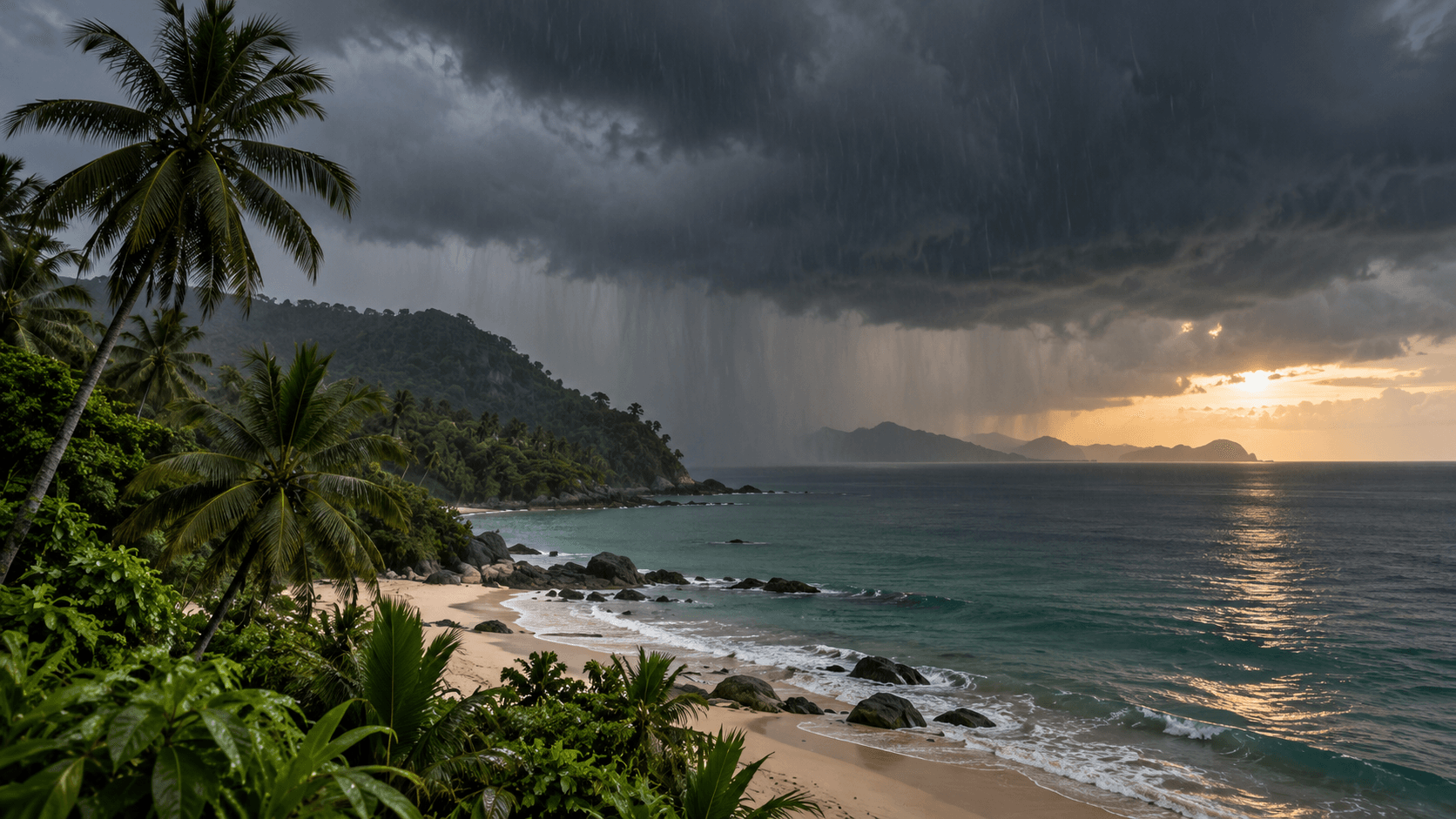
In 2026 the meteorological service announced the start of the rainy season from 15 May; it will last until October. On the Andaman coast these are the wettest months, and in the Gulf of Thailand — October to December.
Where it rains less in summer
In June – August it is drier in Samui, Phangan and Tao. Hua Hin and Pattaya are also less rainy than Phuket, but downpours happen there.
Can you swim in the sea in the rainy season
You can, if you choose sheltered bays and watch the flags. On the Andaman coast in summer there are dangerous currents and waves, and swimming at open beaches is sometimes prohibited, so go by the lifeguards rather than the weather app. In Samui the sea is more often calm in summer.
Pros and cons of a vacation in the low season
Pros: fewer tourists and lower accommodation prices. Cons: downpours, some boat tours do not run, the sea in Phuket is rough, and some restaurants and beach venues do not operate every day. If your schedule is flexible, the low season is an option for a quiet vacation without crowds.
When is the best time to go to Thailand for different types of vacation
For a beach vacation and swimming
The dry period suits the beach: in Phuket and Krabi from November to April, in Samui and Phangan from January to September. The calmest sea on the Andaman coast is in winter.
For a vacation with children
Choose months without strong heat and without a stormy sea. The best option is winter in Phuket or Krabi, and summer in Samui. April, with heat up to 36 °C in the city, is hard on small children, and in the rainy season on the Andaman coast beaches are often closed for swimming.
For excursions and travel
For sightseeing in cities and temples the cool period from November to February suits best, when walking outdoors is not exhausting. If you plan trekking in the north, the same period is optimal.
For diving and snorkeling
In the Gulf of Thailand at Tao the best conditions are from February to May, and from September to October good conditions return with fewer tourists. On the Andaman coast diving runs from October to May (Phuket, Krabi, Koh Lanta, Koh Lipe); Similan — from 15 October to 15 May. For underwater visibility, January – March is best.
For surfing and active vacations
Waves on the Andaman coast come in the rainy season, so surfers go to Phuket from May to October, when other tourists leave. For cycling, trekking and rock climbing the cool months are more comfortable.

When is it cheaper to travel to Thailand
How the season affects accommodation costs
In the high season hotels and villas are more expensive, and in December and January they are booked in advance. In the low season owners more often make concessions: long-term rental works the same way — more in the article how to rent accommodation in Thailand.
Flight and excursion prices in the high and low season
Flights in December and January, especially for the holidays, are usually more expensive than in May – October. Excursions in the rainy period are more often cancelled because of the weather, so it is better to keep boat tour dates flexible. Exact prices depend on the destination and date, so compare offers several weeks before the trip.
In which months you can save on a trip
The most economical are May, June and September – October for the Andaman coast and November for some destinations at the start of the dry period. For Samui, savings are possible in the low season of that particular coast — in October – December. If you want good weather at reduced prices, look for the "shoulders" of the season: the end of April, May and November.
How much money to bring to Thailand depending on the season
The budget in the high season is usually higher because of accommodation, and in the low season more goes on transport if plans change because of the weather. Allow a reserve for unexpected expenses and prepare baht in advance — for example, exchange rubles through EXFM before departure. How to calculate the amount and in what form to carry money is in a separate article on how much money to bring to Thailand.
How to exchange money for a vacation in Thailand
Travel conditions depend on the season, but the way of paying does not: in Thailand baht is accepted. Prepare it in advance so you do not have to look for an exchange office on the first day.
Looking for an exchange point on the first day of a trip is not always convenient — especially in the rain or with luggage. You can send a baht request to an EXFM manager in advance — calculate the amount, the manager will confirm the rate before the exchange, and you can pick up the money at an office, from a courier or by transfer to a Thai account.
Which currency to bring
Rubles are not accepted everywhere, and Russian bank cards do not work in Thailand — more in the article on how to pay in Thailand. Paying in baht and exchanging a currency that exchange offices accept is more practical.
Where to exchange rubles for Thai baht
EXFM exchanges rubles and Online USD for baht: cash at offices in Phuket, by courier or by transfer to a Thai account. The manager confirms the rate before the exchange, and for amounts from 49,999 THB it is more favorable. The company operates under Bank of Thailand license No. MC225670007. You can calculate the amount on the ruble-to-baht exchange page.
How to get cash baht at popular resorts
In Phuket, baht can be received at EXFM offices (Surin, Karon, Rawai) or by ordering a courier: delivery is free from 15,000 THB, and below that amount it costs 300 THB. In Pattaya, Bangkok, Samui and Hua Hin courier delivery is available, and in any region — a transfer to a Thai bank account. A courier in Phuket and other cities can be ordered in advance, before departure.
Holidays and festivals in Thailand
Holidays affect the choice of month: on these days transport is busy, some venues are closed, and accommodation prices are higher. The dates of some holidays move, so check them closer to your trip.
Songkran — Thai New Year
The main holiday is from 13 to 15 April (in 2027 — Tuesday to Thursday). These are national days off and mass water festivities in the streets; in some cities they last longer. If you do not want water and crowds, it is better to choose another month.
Loy Krathong
The festival of lights and floating leaf baskets takes place on the full moon of the 12th lunar month — in 2026 this is 24 November (some sources give 25 November, so check the program on the Tourism Authority of Thailand website). In 2027, 14 November is expected. In Chiang Mai the Yi Peng lantern festival also takes place on this day.
Chinese New Year
In 2027 — 6 February. Thai cities with a large Chinese community, such as Bangkok and Phuket, celebrate it with processions and decorations, and there are more tourists on these days.
New Year and Christmas holidays
Christmas and New Year are the peak of the high season: accommodation and ticket prices are the highest, and there may be no rooms available. Book in advance.

Frequently asked questions about seasons in Thailand
When is the highest season in Thailand? From November to February, with the peak in December – January and the holiday weeks.
Which month is best to fly to Phuket? From November to April; for calm seas and fewer tourists — November or April.
Where is it best to vacation in Thailand in summer? In Samui, Phangan and Tao — in June – August it is drier there than in Phuket and Krabi.
When is the rainy season in Samui? The main rains are from October to December; at the start of January precipitation is still possible.
Can I vacation in Thailand in September? Yes, but on the Andaman coast it is a rainy month with rough seas; in Bangkok, September is one of the rainiest. For September, look at Samui or Phangan.
When are prices lowest in Thailand? In the low season — from May to October on the Andaman coast, and from October to December in Samui. The size of discounts depends on the hotel and the date.
Which month has the calmest sea? On the Andaman coast — from November to April, in Samui and Phangan — from January to September.
When is the best time to go to Thailand with children? In winter to Phuket or Krabi, in summer to Samui; April is hot, and in the rainy season on the Andaman coast beaches are often closed for swimming.
Summary: which month and resort to choose for your vacation
Looking at the season from the other side — not "when is it good in Thailand" but "where in Thailand is it good on my particular dates" — the choice becomes simpler. Winter — Phuket, Krabi, Phang Nga and Bangkok; summer — Samui and Phangan; in autumn check the specific island and the forecast. For a quiet vacation without crowds you can fly in the "shoulders" of the season: the end of April, November, the start of May.
Once the dates are chosen, prepare baht in advance: EXFM will exchange rubles or Online USD and issue cash at an office in Phuket, by courier, or transfer to a Thai account. Calculate the ruble-to-baht exchange or write to a manager — they will confirm the rate before the exchange.