Where to Exchange Money in Thailand: The Best Ways to Change Currency
Where to exchange money in Thailand: at specialised exchange offices, banks, airports, hotels or online services. The rate and fees differ everywhere, so below is a comparison of methods, tips on currencies and rules for safe exchange.
The Thai baht (THB) is the national currency, and it is what you pay with across the country. If you are flying to Thailand for the first time, the question of exchange comes up on the very first day, so work through the options in advance. Below are the ways in which the rate and conditions are clear before the transaction. Foreign currency is accepted in different places, but conditions differ.
Where can you exchange money in Thailand
Specialised exchange offices
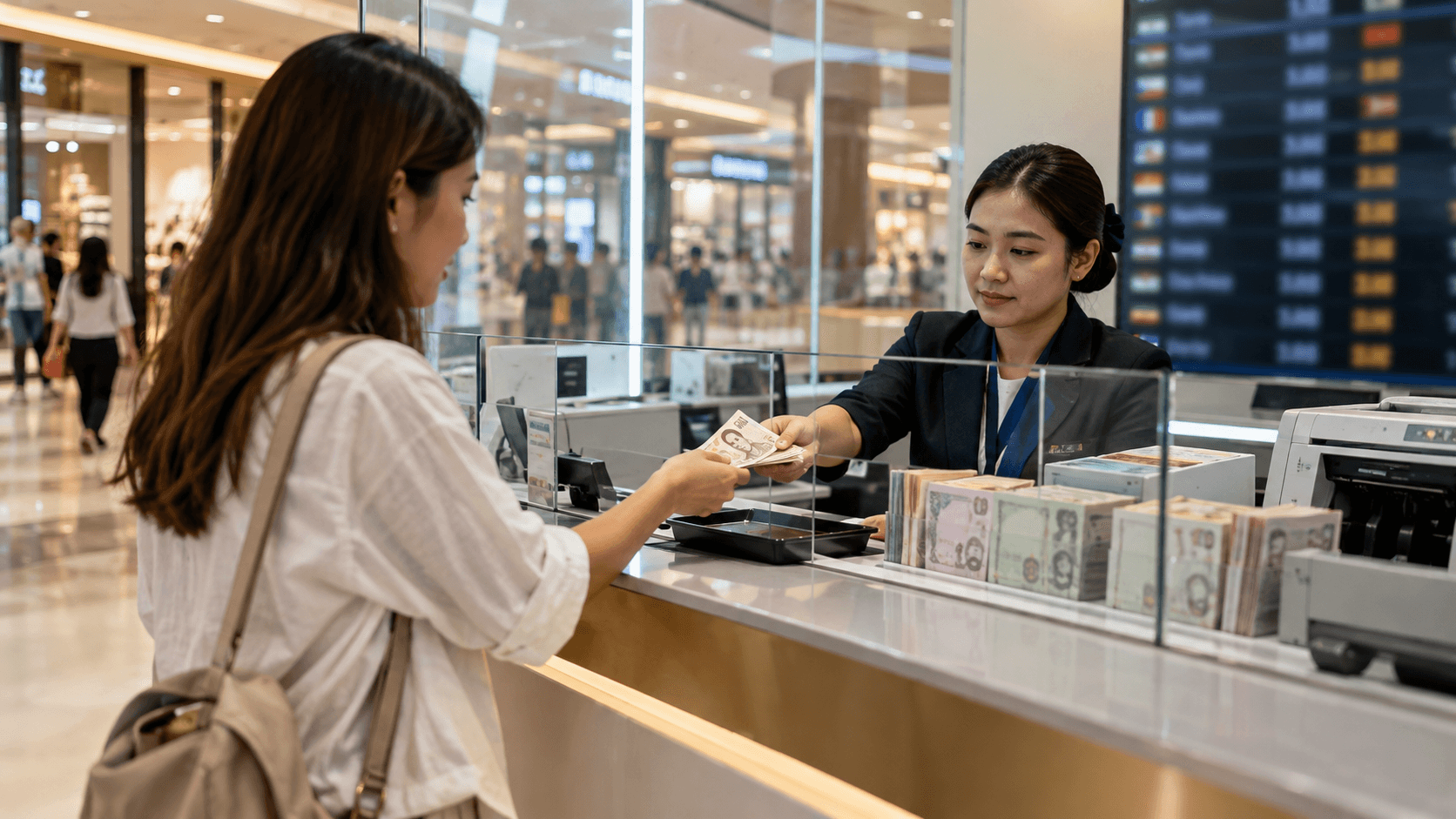
Specialised offices work in shopping malls and on tourist streets and usually offer a better rate than banks. The board shows each currency and the rate by denomination, and the amount is calculated in front of you. For large bills the rate is better than for small ones.
Banks and bank branches
Banks are reliable and work under official rules, but the rate is usually less favourable and the opening hours are shorter. A passport is needed.
Currency exchange at airports
Airport offices are convenient right after arrival, but the rate is often worse than in the city. Change only a small amount there — for example, for a taxi and a mobile connection.
Exchanging money in hotels and tourist zones
Exchange in hotels is convenient, but the rate is, as a rule, unfavourable. In tourist zones the rate depends on the specific office: compare two or three options nearby.
Online currency exchange services
Online services let you lock the rate in advance and receive baht in cash or into an account: you can submit a request even before the flight to Thailand, and the currency is fixed at order placement. A licensed service operates under Bank of Thailand rules.
| Method | Rate | Fees | Currencies | Convenience | Limits |
|---|---|---|---|---|---|
| Exchange office | Usually better | Most often built into the rate | Major | Medium | Depends on the denomination |
| Bank | Less favourable | May be charged separately | Major | Low | Opening hours, passport |
| Airport | Often worse | Built into the rate | Major | High | A small amount is better |
| Hotel | Unfavourable | Built into the rate | Limited | High | Guests only |
| Online service | Fixed in advance | Clarified before the exchange | Depends on the service | High | A request is needed |
Where is it better to exchange money in Thailand
How to compare exchange rates
Compare not only the buy rate but also the final amount in hand: the rate is easy to find on the board and on offices' websites, but a fee can be hidden. Ask how many baht you will receive and ask for the calculation before the transaction. Each currency and each denomination has its own rate.
Where is it better to exchange large amounts
Large amounts are more convenient to exchange in one proven place or through a licensed service: for bigger transactions the rate usually improves. Do not carry significant sums of cash around the streets and do not bring them to Thailand unnecessarily.
How to avoid double conversion and hidden fees
Double conversion occurs when dollars are first turned into another currency and then into baht. Each stage is a separate fee. A direct transaction in the right currency reduces losses: count the result in baht, not in percentages of difference.
Where to exchange money in popular Thai resorts
Currency exchange in Phuket
In Phuket there are exchange offices in shopping malls and on the streets of Patong, Kata and Karon, and EXFM accepts a transfer in a foreign currency and issues baht at an office, by courier or to a Thai account. The rate in Phuket depends on the area: in the most tourist zones it is usually worse, so compare two or three offices.
Currency exchange in Pattaya
In Pattaya exchange offices work on the main streets and in shopping malls; compare the rate in several places.
Currency exchange in Bangkok
Bangkok offers a wide choice: network exchangers, banks, shopping malls. Rates differ from area to area, so compare offers.
Currency exchange in Samui
On Samui the offices are concentrated in tourist areas, so the rate may be less favourable than on the mainland. Plan your exchange in advance.
Currency exchange in Hua Hin
In Hua Hin exchange is easier to arrange at banks and offices in the city centre; prepare a large sum in advance.
Which currency is better to exchange for Thai baht
There is no universally better currency: which currency is more favourable depends on the buy rate, the sell rate and additional costs. The rates of the "dollar — baht" and "euro — baht" pairs change daily, as does the Thai baht against other currencies. Which currency to bring to Thailand, decide after comparing the conditions.
Exchanging US dollars for baht
US dollars are accepted almost everywhere. If you bring dollars, take large 50 and 100 dollar bills: small-denomination dollars are accepted at a reduced rate. Old, torn and very crumpled banknotes may be refused.
Exchanging euros for baht
Euros are exchanged almost everywhere, but the rate can be less favourable than for dollars. Large bills are better here too.
Exchanging rubles for baht
Russian currency is not accepted everywhere, and the rate depends strongly on the channel. Details are below.
Exchanging Chinese yuan for baht
Yuan are accepted at the main offices, but the choice is limited. Check the terms for yuan in advance.
| Currency | What to consider |
|---|---|
| US dollars | The best rate for large bills; small ones at a reduced rate |
| Euros | Widely accepted; the rate depends on the office |
| Rubles | Not accepted everywhere; online is more convenient |
| Yuan | Accepted at the main offices |
How to exchange rubles for baht in Thailand
Exchanging cash rubles
Cash Russian currency is not accepted everywhere, and the rate is usually less favourable. Check in advance whether the office accepts it.
Exchanging rubles through specialised services
A licensed service lets you exchange rubles by a cashless transfer from a Russian bank. EXFM operates under Bank of Thailand licence No. MC225670007, and the manager confirms the rate and amount before the transfer. Calculate an exchange of rubles to baht.
Getting cash baht without a foreign bank card
Thai baht can be received in cash at an office or by courier, without opening a foreign bank account.
Transferring baht to a Thai bank account
If you have a Thai account, Thai baht can be transferred to it directly. The manager confirms the amount in baht before the transfer.
Can you exchange money in Thailand with a Russian card
Which Russian bank cards work in Thailand
Visa and Mastercard payment products issued by Russian banks, as a rule, do not work abroad. A detailed breakdown is in the article on payment instruments.
Alternative ways to get baht
An alternative is to exchange cash or use an online service. For payment methods, see the article how to pay in Thailand.
What documents are needed to exchange currency in Thailand
Do you need a passport to exchange money
A bank requires a passport; exchange offices may ask for it for a large sum. Take the original or a copy and [CONFIRM: the amount threshold from which an office must request a passport].
Are there limits on exchange amounts
Limits depend on the office and on the foreign-exchange control rules. Bringing in and taking out large amounts of cash must be declared, so on entering Thailand check your amount against the limit:
How to exchange a large sum safely
Exchange a large sum at a licensed office, ask for the calculation before the transaction and count the bills. A cashless transfer removes the need to carry cash across the border into Thailand.
How to exchange money safely in Thailand
How to check an exchanger's reliability
If you have come to Thailand for the first time, look at whether the office has a licence, a rate board and a receipt. Study reviews and the operator's official data.
How to avoid fraud and an unfavourable rate
Do not agree to a deal without a calculation and do not accept a "special rate" from strangers on the street. Ask how many baht you will receive.
How to check bills and count money
Count the bills in front of the cashier and compare with the receipt. Check that there are no torn or glued banknotes.
Frequently asked questions
Where is the best place to exchange money in Thailand?
At licensed exchange offices and through online services with a clear rate.
Where is it better to exchange currency — at the airport or in the city?
Usually in the city. At the airport, change a small amount.
Can I exchange Russian rubles for baht?
Yes, most often through a licensed service by cashless transfer.
Which currency is best to bring for exchange in Thailand?
US dollars and euros are accepted more widely. It is better to take large bills and compare rates before flying to Thailand.
Where can I exchange money in Phuket?
At exchange offices in shopping malls and on tourist streets, or through EXFM.
Where can I exchange rubles for baht in Pattaya?
Cash rubles are not accepted everywhere; an online service with receipt to a Thai account is more convenient.
Can I get baht without a foreign card?
Yes: in cash at an office, by courier or to a Thai account.
Do I need to show my passport when exchanging currency?
At banks — yes; at exchange offices it may be required for a large sum.
Conclusion
For a small amount brought to Thailand, a city exchange office will do; for a large one, a licensed service with a rate fixed in advance. Any currency is more favourable at an office where the calculation is visible before the transaction. Check the current EXFM rate or message a manager.