Thai Phrasebook for Tourists: Key Words and Phrases with Translation and Pronunciation

You do not need a large vocabulary to travel in Thailand. A dozen words and a polite particle at the end of a sentence are enough: locals notice the effort and respond warmly. Below are Thai phrases for tourists with translation and pronunciation, sorted by situation: airport, hotel, taxi, café, market and emergencies.

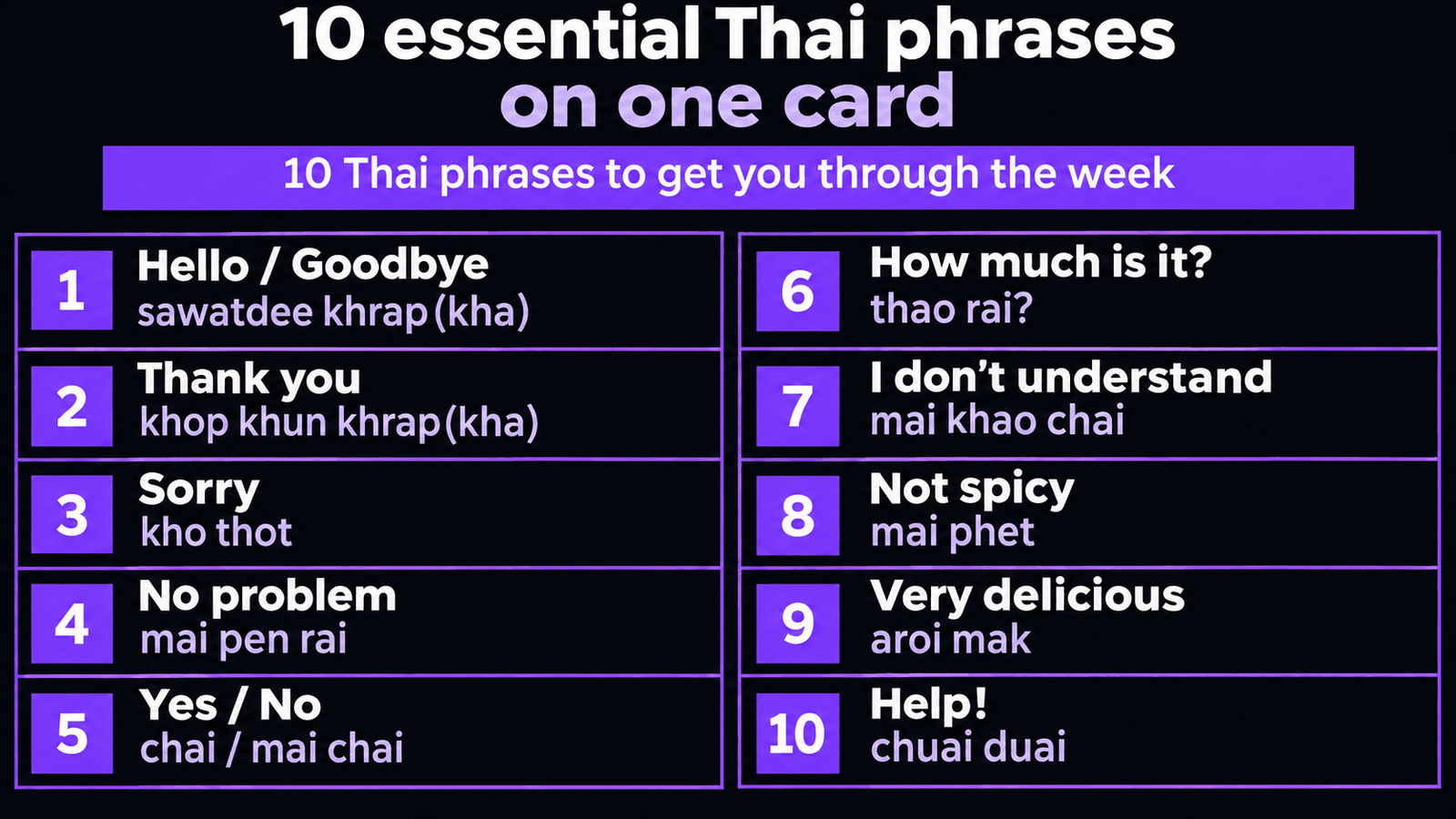
Cheat sheet: ten phrases that cover a week
If you learn nothing else, learn these ten. The romanisation is approximate: Thai is tonal and no alphabet captures it fully.
| Phrase | Pronunciation | Meaning |
|---|---|---|
| Hello / goodbye | sawatdee khrap (kha) | Universal greeting and farewell |
| Thank you | khop khun khrap (kha) | Gratitude |
| Excuse me / sorry | kho thot | An apology or "with your permission" |
| No problem | mai pen rai | Reply to an apology or thanks |
| Yes / no | chai / mai chai | Confirming and denying |
| How much? | thao rai? | Asking the price |
| I do not understand | mai khao chai | When you did not follow |
| Not spicy | mai phet | In a café |
| Very tasty | aroi mak | A compliment to the cook |
| Help! | chuai duai | Only in real trouble |
Features of the Thai language: what a tourist should know
Thai sounds unfamiliar, but three rules are enough for a phrasebook: tones change meaning, the polite particle depends on the speaker's gender, and rhythm matters more than perfect pronunciation.
Tones and pronunciation of Thai words
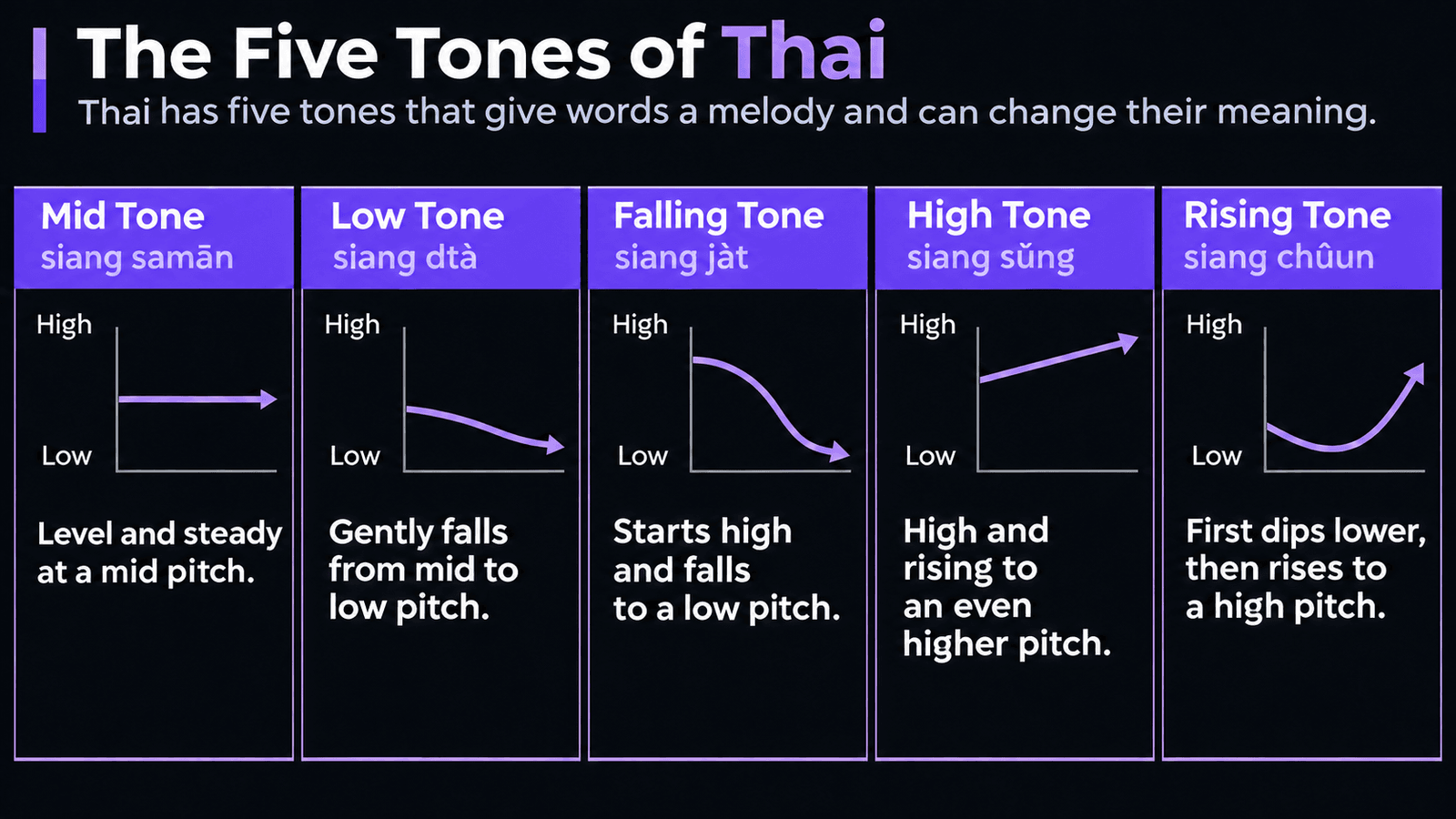
Thai has five tones: mid, low, falling, high and rising. One syllable in different tones means different things: "mai" can be "not", "new" or a question particle. Do not try to learn tones in an evening. It is better to listen to how Thai people speak and repeat the melody of the whole phrase. Vowel length matters too, and romanisation shows it only roughly.
The polite endings "khrap" and "kha"
A polite word is added at the end of a phrase. A man says "khrap" (in speech it sounds like "krap"), a woman says "kha". The choice depends on the gender of the speaker, not the listener. At the end of a question a woman changes the tone and says "ka". Without the ending a phrase sounds abrupt, so "sawatdee" with the particle is better than without it.
| Who speaks | Statement | Question |
|---|---|---|
| A man | khrap | khrap |
| A woman | kha | ka |
Basic Thai words and expressions
Greeting and farewell
"Sawatdee khrap" (or "kha") works in the morning, afternoon and evening, and when parting. Thai people rarely use the separate word "laa kon": it sounds too final. More often they say "sawatdee" or the English "bye-bye". You can ask "how are you?" with "sabai dee mai?" and answer "sabai dee". The word "sabai" generally means "comfortable, relaxed", and "sabai-sabai" is built from it: "take it easy".
Thanks and apologies
Thank you in Thai is "khop khun khrap" (a woman says "khop khun kha"). Phrasebooks also spell it "kop kun". To say "thank you very much", add "mak", meaning "very". You can apologise with "kho thot". The reply to an apology is "mai pen rai" ("no problem"), but it is not a replacement for "sorry": to apologise yourself, use "kho thot".
Yes, no and other everyday expressions
| In English | Pronunciation | Comment |
|---|---|---|
| Yes, right | chai | Confirming "that is so" |
| No, not so | mai chai | Denial |
| Can / possible | dai | The answer "yes, you can" |
| Cannot / not possible | mai dai | Refusal |
| Really? | ting mai? | Surprise |
| Agreed | tok long | Agreement after a deal |
| Good luck | chok dee | A wish |
| Faster | reo-reo | A request to hurry |
Meeting and chatting with locals
How to introduce yourself
Speaking about himself, a man says "phom", a woman says "dichan". "My name is" is "phom (dichan) chue…", and "I am from Russia" is "phom (dichan) maa chak rat-sia". "Nice to meet you" is "yindee tee dai ruu jak". A smile and a light bow with palms at the chest work too: the wai is the familiar Thai greeting gesture. If words fall short, you can manage with gestures and a translator on the screen.
Popular questions and answers
| Question | Pronunciation | What to answer |
|---|---|---|
| Where are you from? | khun maa chak nai? | "I am from Russia" — "maa chak rat-sia" |
| How are you? | sabai dee mai? | "Sabai dee" — fine |
| Do you speak English? | phuut phasaa angkrit dai mai? | "Dai" (yes) or "nit noi" (a little) |
| Please speak more slowly | phuut chaa-chaa noi | A request for a pause |
| I do not understand | mai khao chai | A universal reply |
If you did not follow the person, say "mai khao chai" — "I do not understand". It is the most useful phrase for a tourist: they will repeat it more slowly or show you with a gesture.
Slang and Thai "rhythm": the word "sabai" shows up in advertising, and in messages Thai people laugh with the digits "555" — in Thai "five" sounds like "ha". Do not repeat swear words from videos: without knowing the tone it is easy to cause offence.
What to say at the airport and hotel
At the airport
In airports and large hotels English is usually enough: passport control and check-in go without Thai. But a couple of words come in handy. Airport is "sanambin", taxi is "taxi", toilet is "hong nam". To ask where the toilet is, say "hong nam yuu tee nai?".
When checking in at a hotel
| In English | Pronunciation |
|---|---|
| Hotel | rong raem |
| Is there a free room? | mii hong waang mai? |
| Where is the toilet? | hong nam yuu tee nai? |
| Thank you for your help | khop khun khrap (kha) |
The hotel will ask for your passport to register you as a guest, and the key card can be asked for in English: "key card". Which other phrases you need depends on the place: in small guesthouses staff often speak English less well than in chain hotels.
What to say in a taxi and on the road
How to explain the route to a driver
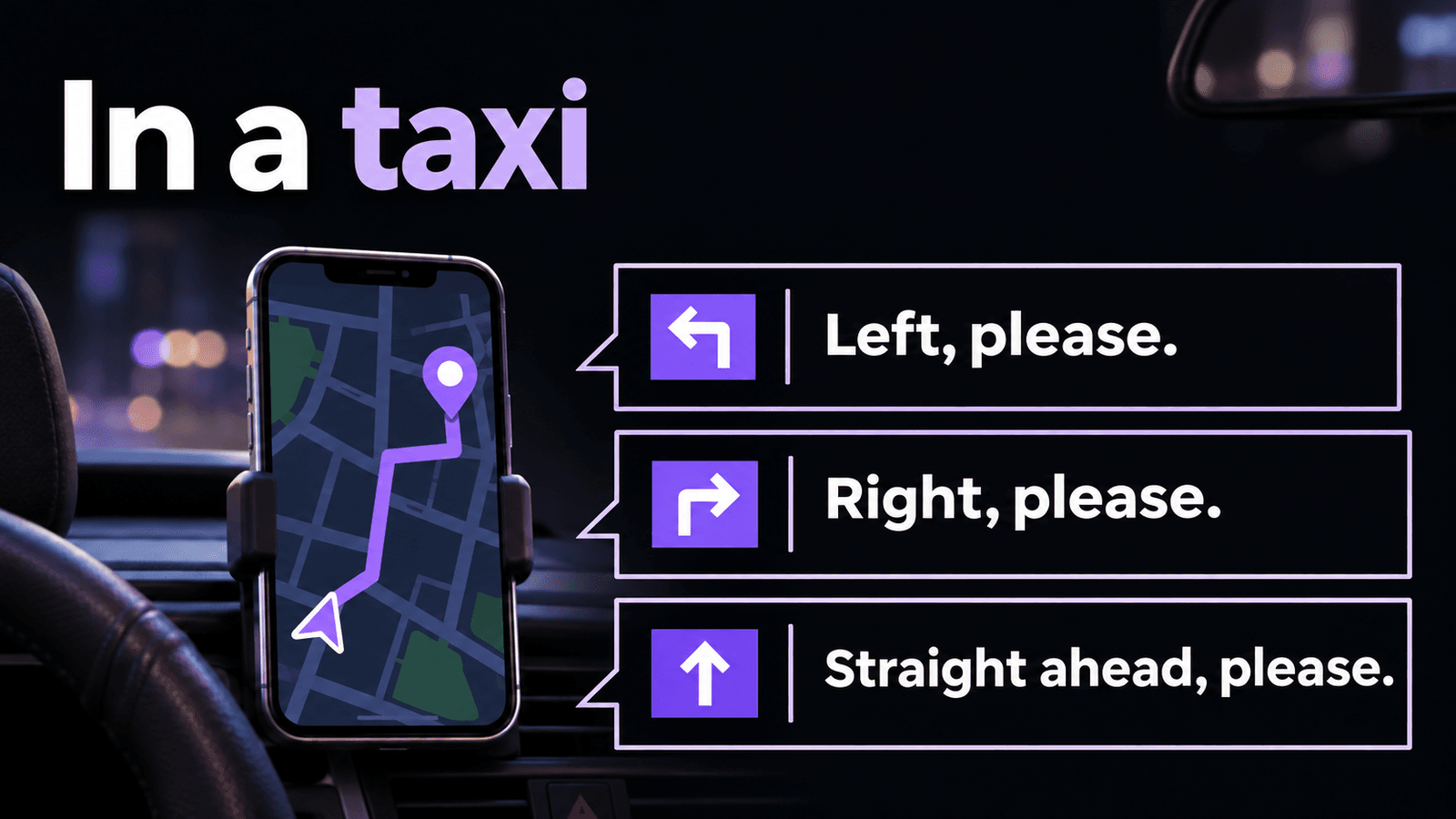
Show the address on your phone screen: that is the easiest way. If you need words, use short commands. In a taxi without an app, agree the price in advance and ask "pai … thao rai?" ("how much to …?").
| In English | Pronunciation |
|---|---|
| Left | liao saai |
| Right | liao khwaa |
| Straight | trong pai |
| Stop here | chot tee nee |
| Faster | reo-reo |
| How much to …? | pai … thao rai? |
How to ask for directions
Start with "kho thot" ("excuse me"), then name the place and add "yuu tee nai?" ("where is it?"). Point on the map instead of only speaking: Thai names sound different from the Latin spelling. If the answer comes fast, say "phuut chaa-chaa noi" — "speak more slowly".
Thai phrasebook for cafés and restaurants
How to order food and drinks
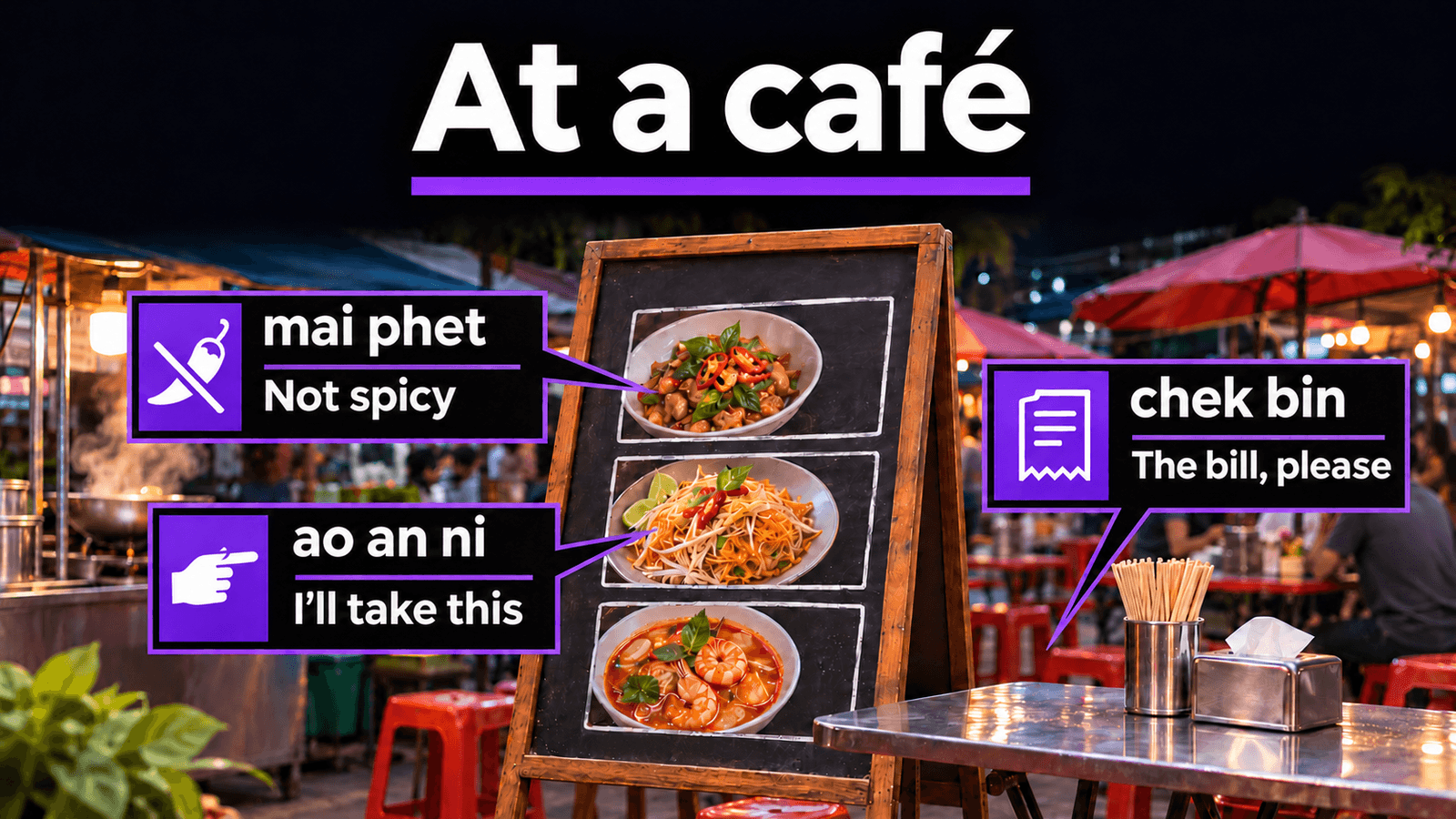
In a café you can order by pointing at the menu and saying "ao an ni" ("I want this"). Water is ordered with "ao nam nueng kuat" ("a bottle of water"), fresh-squeezed juice with "nam phon lamai sot". Takeaway is "kab-baan".
How to ask for a dish that is not spicy
| In English | Pronunciation | When to use |
|---|---|---|
| Not spicy | mai phet | Ordering a dish |
| Without chilli | mai sai phrik | To remove the heat entirely |
| I cannot eat spicy food | kin phet mai dai | If you fear the heat |
| Very tasty | aroi mak | After the meal |
Keep in mind that "mai phet" does not always save you. Chilli may already be in a ready-made sauce, so for a strict "no heat" add "mai sai phrik" and "kin phet mai dai".
How to ask for the bill
The bill is "check bin" (the English "check bill" has long entered Thai), and with "duai" it becomes the polite request "check bin duai". Large tips are not required in Thailand: people usually leave small coins or round the sum up. Change is called "ngoen thon".
Shopping in stores and markets
How to ask the price
The price is asked with "thao rai?" ("how much?"). Sellers often show the sum on a calculator. If you need cash for the market, prepare baht in advance: where to exchange money in Thailand is in a separate article, and the next section helps you understand the numbers.
How to ask for a discount
Haggling is accepted at markets, while prices in malls and supermarkets are fixed. You can ask for a discount with "lot dai mai?" ("can you lower it?"). If the price seems too high, say "phaeng pai" ("too expensive"). Bargain with a smile: concession is a game, not a conflict. When you agree, say "tok long".
Numbers in Thai
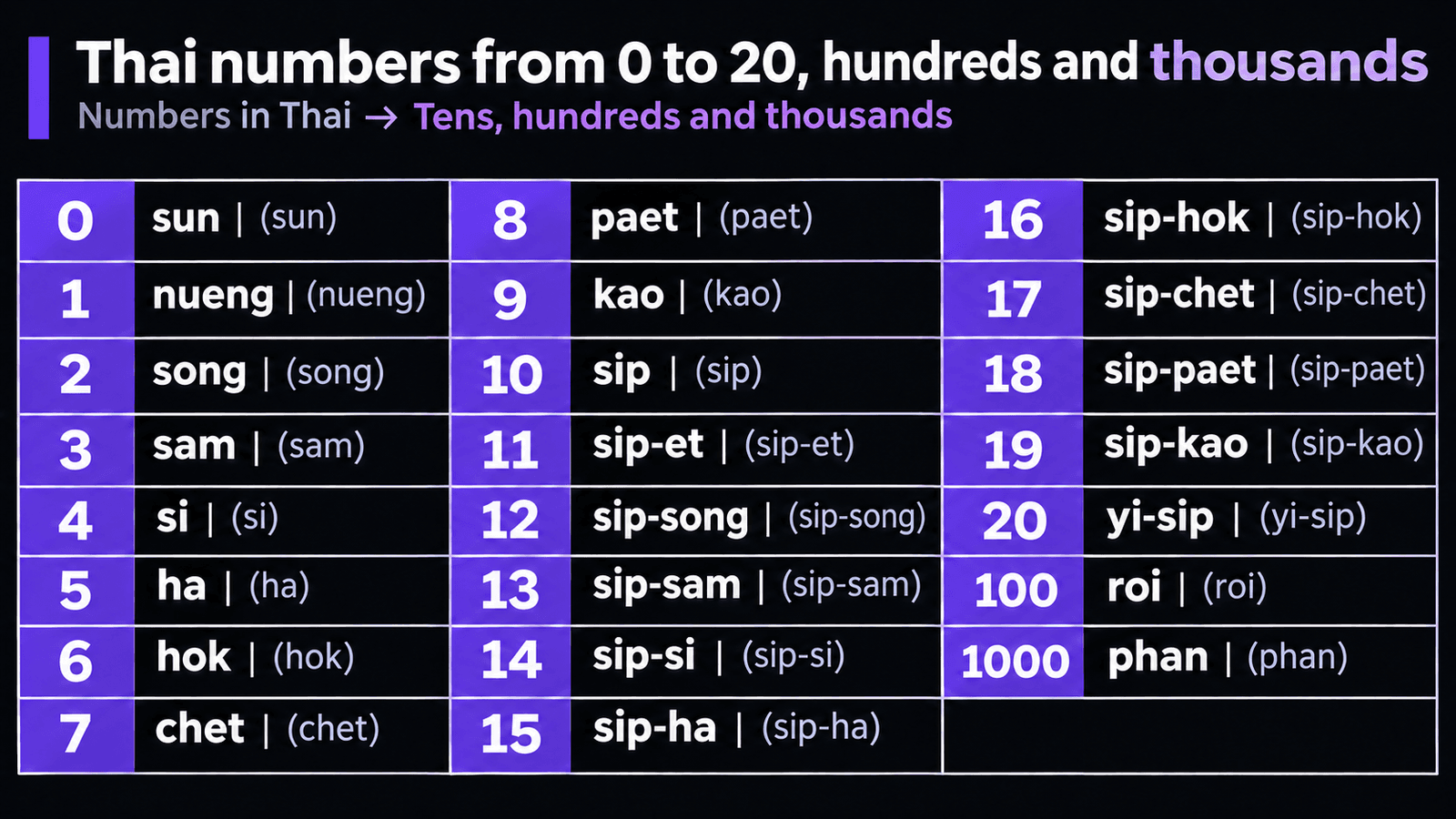
Numbers from 0 to 20
| Number | Pronunciation | Number | Pronunciation |
|---|---|---|---|
| 0 | suun | 11 | sip-et |
| 1 | nueng | 12 | sip-song |
| 2 | song | 13 | sip-sam |
| 3 | sam | 14 | sip-si |
| 4 | si | 15 | sip-ha |
| 5 | ha | 16 | sip-hok |
| 6 | hok | 17 | sip-chet |
| 7 | chet | 18 | sip-paet |
| 8 | paet | 19 | sip-kao |
| 9 | kao | 20 | yi-sip |
| 10 | sip |
Numbers help you understand a price and give a number. Eleven is "sip-et", not "sip-nueng": the form "et" is used inside a number.
Tens, hundreds and thousands
Twenty is "yi-sip", thirty is "sam-sip". A hundred is "roi", a thousand is "phan". Two hundred is "song roi", two thousand is "song phan". To avoid errors when paying, still check the sum on the seller's calculator.
Emergency expressions
How to ask for help
The phrase "chuai duai" means "help", and it should be used only in real trouble. To call for help, turn to hotel staff or the front desk: they will call the right service. The tourist police in Thailand take calls on 1155, and an ambulance can be called on 1669 — check the numbers on the Tourism Authority of Thailand website before you travel.
At a hospital and pharmacy
| In English | Pronunciation |
|---|---|
| Hospital | rong phayaban |
| Pharmacy | ran khai yaa |
| I feel ill | show where it hurts |
| Police | tamruat |
If you lose documents or belongings
Say "passport hai leo" ("the passport is lost") and contact the tourist police. To replace a document you will have to visit your consulate, and a report of the incident is often requested at the local police station. Photograph your passport in advance and keep the copy apart from the original.
How to remember the main Thai phrases faster
- Learn by situation, not alphabetically: airport, café, taxi. That way words attach to action.
- Copy the rhythm. Listen to how Thai people say "sawatdee khrap" and "khop khun" and repeat the melody, not the letters.
- Start with the ten phrases from the cheat sheet and add two a day.
- Keep a translator with an offline dictionary on your phone: reception can be weak.
- Do not fear mistakes: Thai people more often smile than correct you.
To practise the phrases, everyday topics help: about payments at markets, see the article how to pay in Thailand. If you need baht for the market and taxis, cash exchange in Phuket takes a few minutes.
Frequently asked questions
Can you travel in Thailand without knowing Thai?
Yes. In tourist areas English and gestures are enough, and a dozen phrases from the cheat sheet make communication more pleasant. In small towns without English it is easier with a translator on your phone.
Do people in Thailand understand English?
In hotels, airports and restaurants for tourists, usually yes. At markets, small cafés and with taxi drivers the level varies, and short Thai words and a calculator for prices help.
How do you say hello in Thai?
Say "sawatdee khrap" (man) or "sawatdee kha" (woman) and add a light bow with palms at the chest. The phrase works for goodbye too.
What is the difference between "khrap" and "kha"?
They are polite particles: "khrap" is said by a man, "kha" by a woman. The choice depends on the speaker's gender. In questions a woman says "ka".
Which Thai words are worth learning before a trip?
Sawatdee, khop khun, kho thot, mai pen rai, thao rai, mai phet, check bin and the digits to ten. That is enough to start.
Conclusion
A simple set is enough for a trip to Thailand: a greeting, "thank you", "how much?", "not spicy" and numbers. You will pick up the rest on the spot by listening to locals. What if the words fly out of your head? Smile, show your phone with a translation and say "mai pen rai": locals will understand you without perfect pronunciation.