Types of Thai Land Title Documents: From Chanote to Sor Kor 1
Not every piece of paper that looks like a land title in Thailand actually proves the seller owns the land. Before any money changes hands, it's worth knowing the difference between a Chanote and the half-dozen lower-ranked documents that resemble it.
Why the hierarchy of documents matters
Thailand's Land Code Act B.E. 2497 (1954) recognizes several different kinds of land documents, not just one — and they are fundamentally different from each other. Some register full, surveyed ownership. Others simply record that someone has been using a plot of land, without guaranteeing any right to it. On the surface, the difference isn't always obvious: both look like an official stamped document. The gap becomes very real, though, the moment someone tries to register a sale, a mortgage, or a lease — the Land Department simply won't process that registration for some of these documents.
For a villa with land (as opposed to a condominium unit, where a foreign ownership quota applies instead — see Foreign Ownership Quota in Thai Condominiums), the type of land title is the first thing worth checking, before even viewing the property itself.
Chanote (Nor Sor 4 Jor) — full ownership title
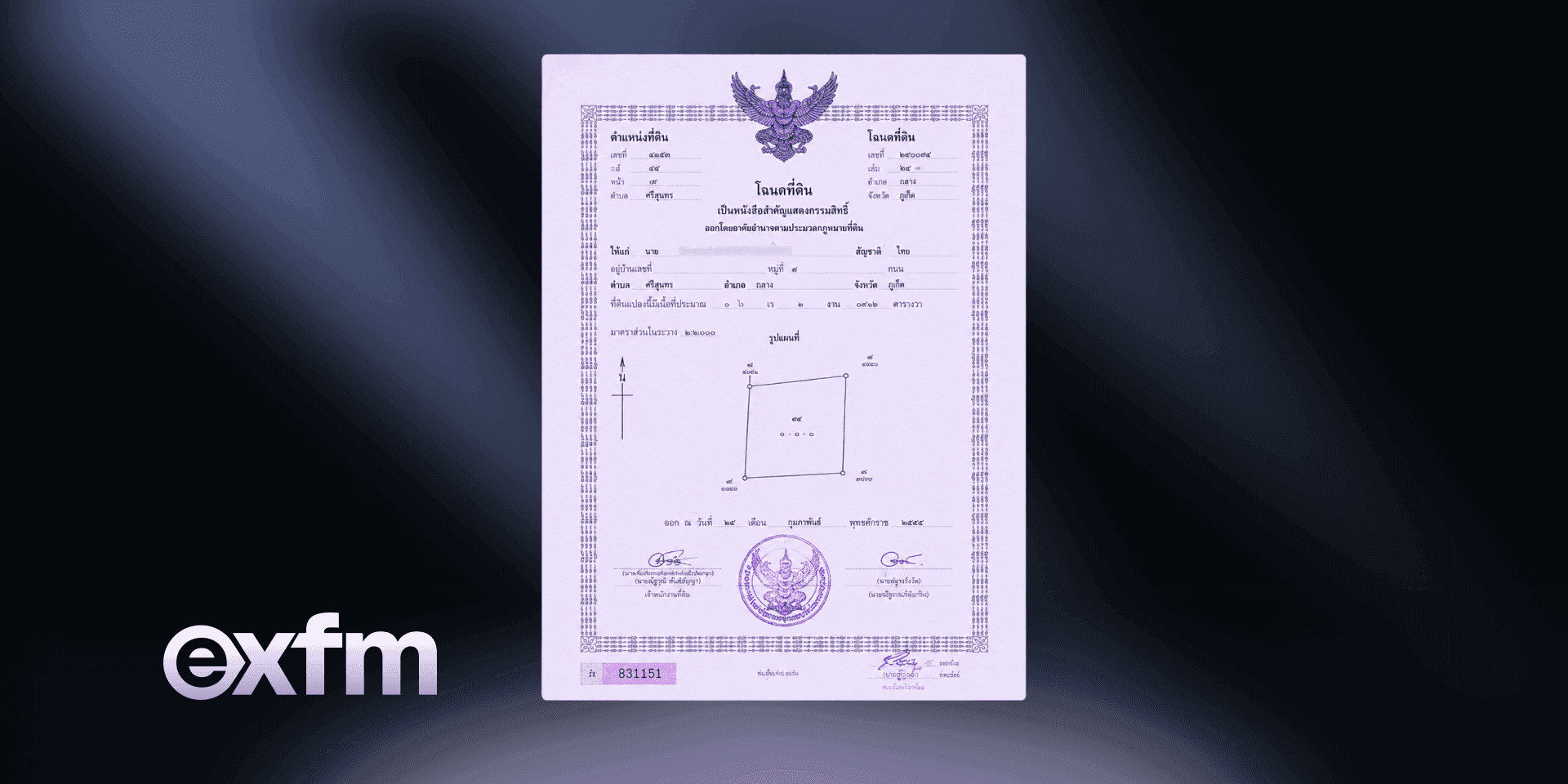
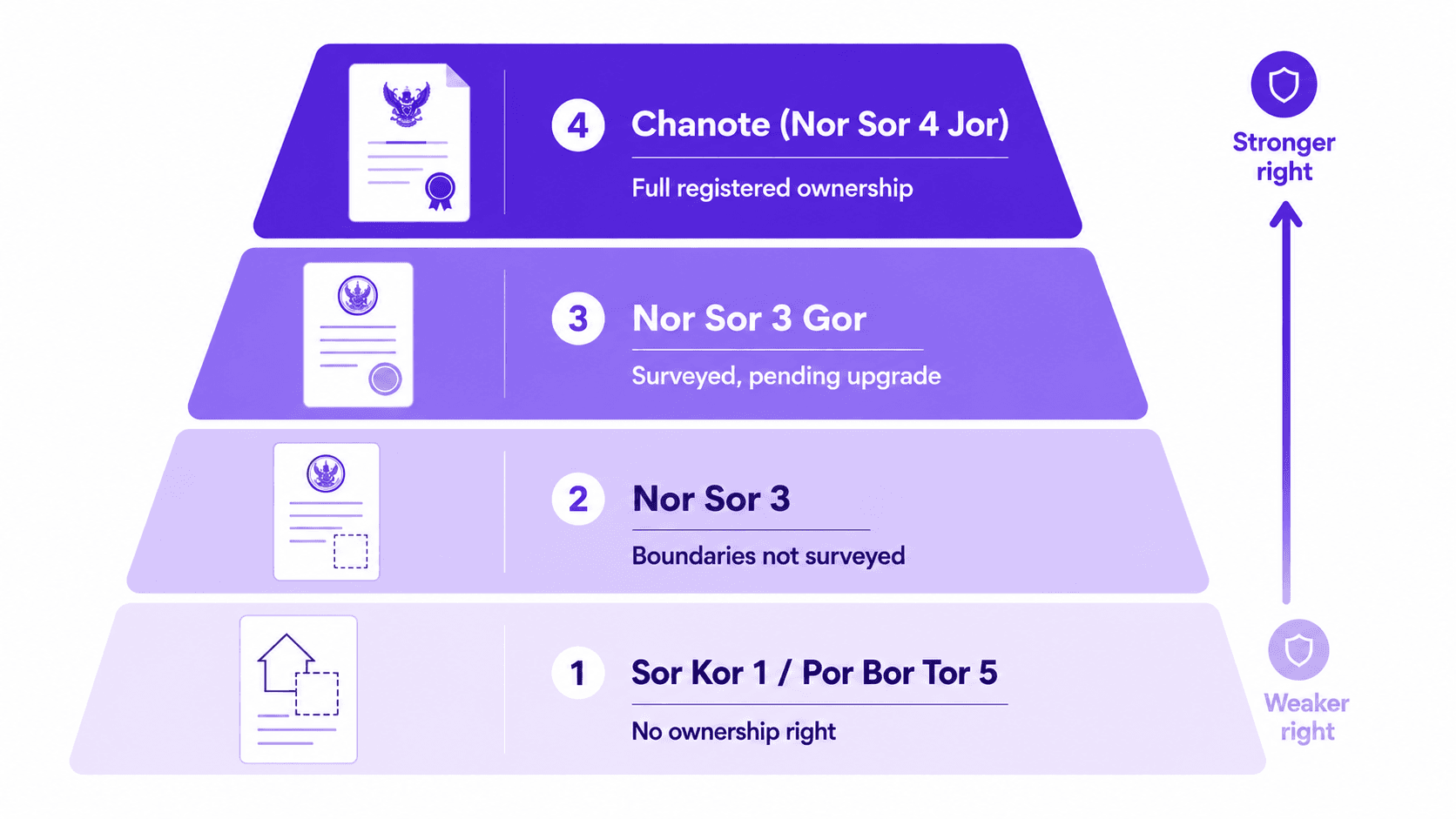
Chanote, formally Nor Sor 4 Jor (N.S. 4 Jor), is the highest-ranking land document in Thailand. The Department of Lands' own official English translation for this term is "Title Deed" — confirmed in its own Land Code glossary (see "Vocabulary from The Land Code", "Issuance of Land Right Document" section). A plot with a Chanote has been surveyed by the Land Department against a fixed coordinate reference, its boundaries are marked with physical survey posts, and the document itself registers full ownership (freehold).
With a Chanote, it's possible without restriction to:
- sell or gift the land;
- register a mortgage;
- register a long-term lease (leasehold) of up to 30 years;
- register other registrable rights — usufruct, superficies, servitude.
That's why FET, Credit Advice, and Chanote and Leasehold vs Freehold: The Difference When Buying Property in Thailand both treat a Chanote as a precondition for safely registering a deal — without one, the Land Department won't register either a sale or a lease of the land.
Nor Sor 3 Gor — almost a Chanote
Nor Sor 3 Gor (N.S. 3 Gor) is issued for land that has already been surveyed by the Land Department with fixed boundaries, but is formally still pending conversion into a full Chanote. In practice, the rights attached to it are close to a Chanote's: the land can be sold, leased, mortgaged, and inherited, and the Land Office registers all of these the same way it would for a Chanote.
The difference is in the document's status: a Nor Sor 3 Gor can later be upgraded to a Chanote on the owner's application, but on its own it isn't one yet.
Nor Sor 3 — boundaries not yet fixed
Nor Sor 3 (N.S. 3) looks similar to the document above at first glance, but the land hasn't yet been surveyed by the Land Department against a fixed coordinate system, and its exact boundaries aren't established. Because of that, land held under this document can't be sold or mortgaged directly — it first has to be surveyed and upgraded to Nor Sor 3 Gor or Chanote status.
For a buyer, this means one thing: if a seller presents a "Nor Sor 3" document as equivalent to a Chanote, that's a mischaracterization — the Land Department won't register a sale of that land in its current status.
Sor Kor 1 and Por Bor Tor 5 — declarations, not titles
Further down the hierarchy are two documents that aren't proof of ownership at all:
- Sor Kor 1 — a declaration of land use filed by an occupant during a specific historical registration period. The Land Department stopped accepting new Sor Kor 1 filings back in 1972. It doesn't confer ownership, land held under it can't be transferred through the Land Office, and no mortgage or lease can be registered against it.
- Por Bor Tor 5 — a document used for local tax assessment of land by local authorities, not by the Land Department. It shows that someone is paying tax on the use of a plot, but on its own it isn't evidence of ownership.
Both documents turn up on the secondary market, especially outside the main tourist areas — and both call for more careful legal due diligence than a plot held under a Chanote.
What this means for a buyer in practice
Before putting down a deposit on a villa or a plot of land, it's worth requesting a copy of the land document and confirming it's actually a Chanote — or at minimum a Nor Sor 3 Gor — and that the details on it (area, boundaries, owner's name) match what the seller is presenting. That check is part of due diligence, which is normally handled by a lawyer independent of the seller and the developer, not by the buyer looking at a photo of the document. Before transferring any money for a property under either of these documents, it's also worth confirming the intended ownership structure — freehold or leasehold — is even available for that specific title, which is covered in more detail in Leasehold vs Freehold: The Difference When Buying Property in Thailand.
Skipping that check and taking the seller's word for it is the most common way to find out about a problem only after the money has already moved: the Land Department verifies the title on registration day, not before, and by then a transfer is nearly impossible to unwind. That's why EXFM steps in only after the title has been checked and both sides are ready to transfer funds: converting a client's money into baht and arranging the transfer so the bank can issue a correct FET or Credit Advice in the buyer's name.
Further reading: the official website of Thailand's Department of Lands — dol.go.th — and the department's own official English glossary of Land Code terminology, produced with Chulalongkorn University — Vocabulary from The Land Code.