
Foreign Ownership Quota in Thai Condominiums: How the 49% Rule Works
49% isn't a rough figure for general reference — it's a specific cap checked before every freehold registration in a Thai condominium. Here's how it's actually calculated and what happens when a building runs out of quota.
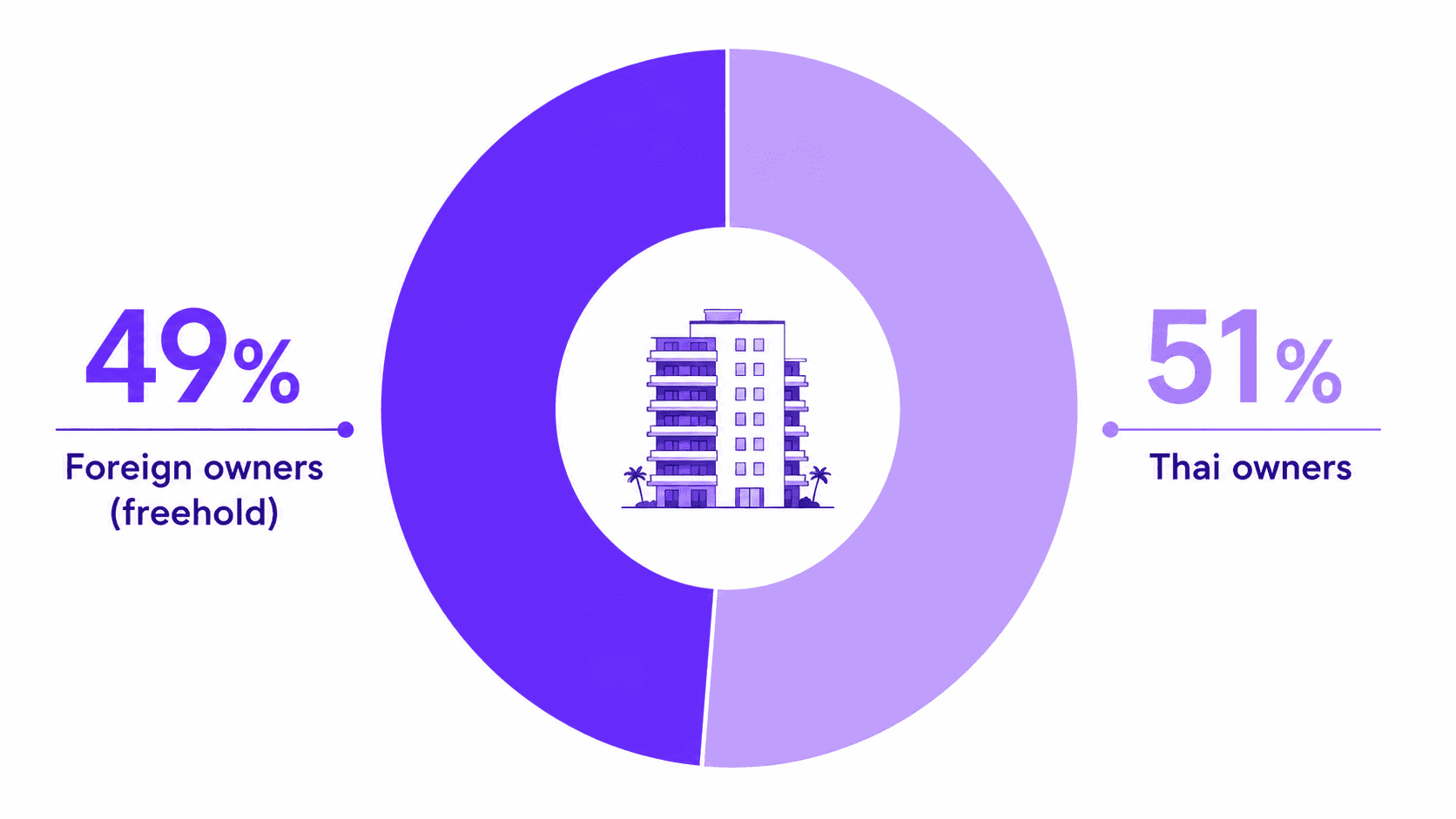
Where the 49% figure comes from
The limit on foreign ownership in Thai condominiums comes from the Condominium Act:
The key phrase is "in any particular condominium." The quota isn't calculated nationally or per developer — it's tracked separately for each registered building (or each phase, if a project is registered as multiple separate condominium juristic entities). A neighboring building by the same developer might still have quota available even if this specific one is already full.
What the quota is calculated against
The 49% is calculated against the total floor area of all units in the building, not the number of units. In practice, that means the split isn't purely mechanical: if foreign buyers tend to favor larger units, the area left for the building's Thai-held share can run out faster than the unit count alone would suggest — or the reverse.
Under the Condominium Act, eligibility for the foreign quota extends to foreigners who:
- are permitted to reside in Thailand under immigration law;
- are deemed under Thai law to be bringing foreign currency into the Kingdom on the required basis;
- or are a foreigner or juristic person permitted to invest under the investment promotion law.
The funds used to buy the unit have to be transferred in from a foreign bank into a Thai account — the receiving bank issues a certificate confirming that transfer, and it's this document that supports the foreign-quota claim at registration. The specific documents involved — an FET or a Credit Advice — are covered in FET, Credit Advice, and Chanote.
Who confirms the remaining quota
Tracking the quota is the job of the condominium's juristic person — the entity that manages the building after registration and keeps count of the Thai-to-foreign ownership ratio across units. Before the Land Department registers a sale, the condominium's juristic person has to confirm that selling this particular unit to a foreign buyer won't push the building past the 49% cap.
In practice, this means it's worth requesting written confirmation from the developer or the condominium office — before putting down a deposit — of exactly how much of the foreign quota is already used and whether room remains for a new purchase. A sales agent's verbal assurance isn't enough here; the confirmation needs to come from the juristic person that's actually accountable to the Land Department for that count.
What happens when the quota is full
If the quota is already fully used, a foreign buyer's freehold right on a new unit can't be registered — no matter how far the deal has progressed or how much money has already been transferred. In that situation, the usual options are:
- wait for quota to free up — for example, if one of the existing foreign owners sells their unit to a Thai buyer;
- consider a different unit in the same development, if it's registered as a separate condominium with its own quota;
- structure the deal as a leasehold instead of freehold — this route isn't subject to the quota, though it changes the nature of ownership (covered in Leasehold vs Freehold: The Difference When Buying Property in Thailand);
- buy the unit in a Thai spouse's name — with the caveat that Thai law treats the Thai spouse as the default legal owner in that case.
That's why checking the remaining quota is worth doing before, not after, transferring money to a developer.
How the quota connects to payment
The quota and the payment are separate but connected registration requirements. Even with quota available, the Land Department won't register a foreign buyer's freehold title without official proof that the purchase funds entered Thailand as foreign currency and were converted into baht through a legal channel — a bank or a licensed service like EXFM. That transfer, together with the document confirming it (an FET or Credit Advice) and the confirmed quota, forms the full package checked on registration day.
Transferring money to the developer before getting written confirmation of the remaining quota is a common mistake: if the quota turns out to already be used up, getting the money back isn't always quick or loss-free. The sensible order is quota confirmation first, transfer second — and that's the step where EXFM comes in, converting a client's funds into baht and arranging the transfer so the bank can issue the correct confirming document in the buyer's name, without needing a trip to Thailand just to handle the payment.
Further reading: the 49% foreign quota rule in the original source — the thailand.go.th portal — and general information on registering condominium rights on the website of Thailand's Department of Lands — dol.go.th.