
Buying Property in Thailand Through a Thai Company: Rules and Nominee Risks
A Thai company is one of the legitimate ways to hold the land under a villa in Thailand. But it's also the structure most often used to disguise land ownership that's off-limits to foreigners — and the one Thai authorities scrutinize most closely, especially in Phuket.
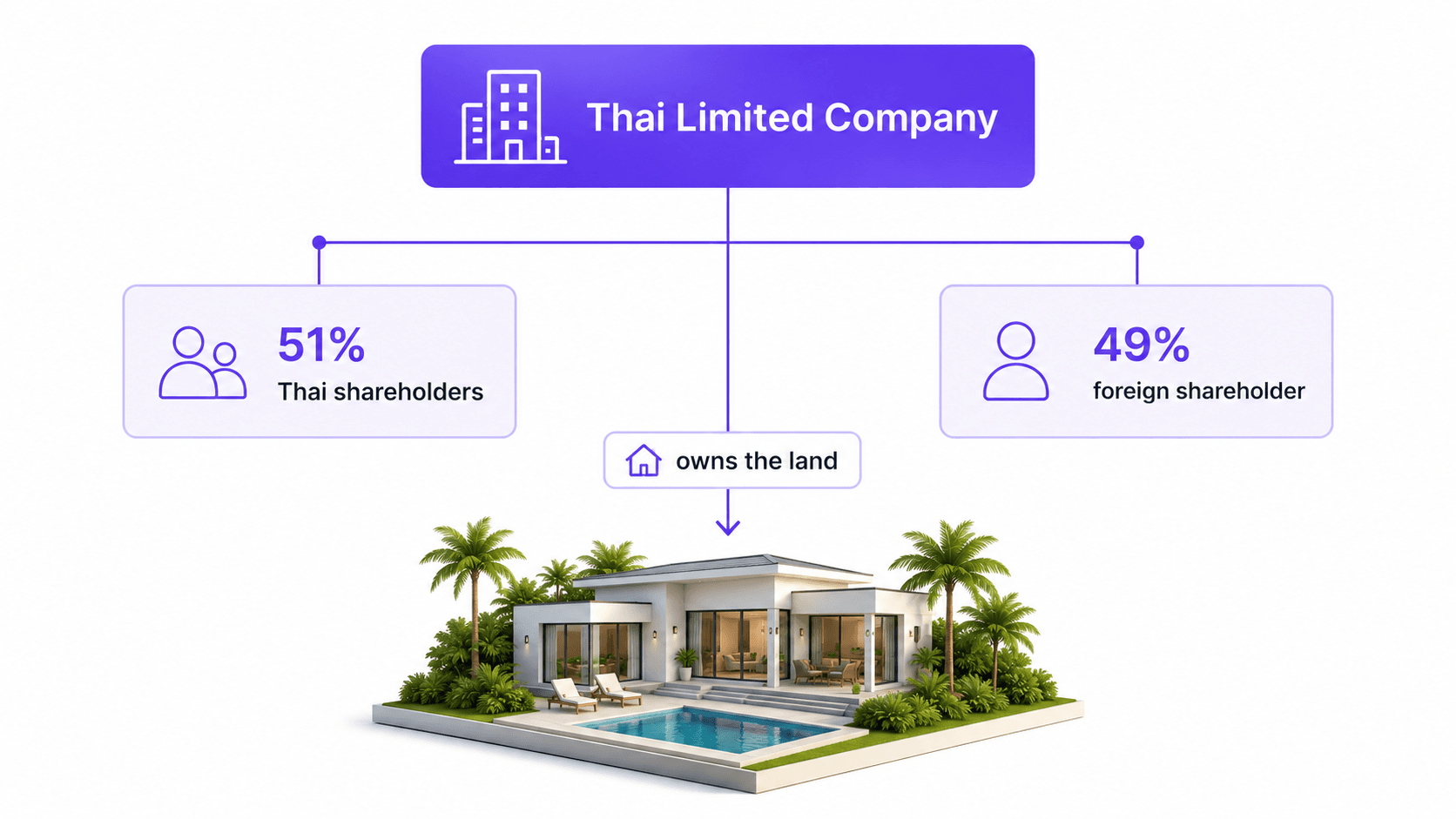
The legitimate structure in three rows:
How the legitimate structure works
The Foreign Business Act B.E. 2542 (1999) sets the threshold of foreign participation at which a company is classified as "foreign" for the purposes of land-ownership restrictions:
In practice, this is the source of the "51% Thai shareholders, maximum 49% foreign" rule: for a company to avoid being classified as foreign — and to be able to own land the way a Thai individual can — Thai shareholders need to hold more than half of its registered capital. A foreigner can still serve as a director and manage the company's operations while remaining a minority shareholder.
Where the line is: the ban on nominee shareholders
The law explicitly prohibits using Thai nationals as nominal shareholders purely to get around this restriction:
An important detail: liability under this section is formally aimed at the Thai side of the arrangement — the nominee shareholder — not directly at the foreigner. But in practice, for a foreign buyer this translates into the risk of losing the asset itself: a court can order the shareholding arrangement to cease, which puts the entire ownership structure built around that company in question.
Why Phuket is under particular scrutiny
This isn't an abstract risk. Thai authorities have already run a targeted check specifically in the real estate sector, and Phuket was at the center of it:
94.6% of all the companies flagged nationwide for suspected nominee arrangements were registered in Phuket. That's a direct signal that on this particular island, the "Thai company holds the villa, foreigner is a nominal minority shareholder" structure sits under active regulatory attention — not a theoretical concern.
More recent data from the same department, published in mid-2026, shows the problem hasn't gone away:
The department refers a portion of these flagged companies to other regulators for further checks — 17,556 of them go to the Land Department specifically for a review of their real estate holdings (the same agency that registers the transfer of ownership), and another 14,800 go to the Revenue Department for a tax review. The same source reports that between October 2025 and June 2026, on-site inspections were carried out at 35 locations across 11 provinces, including Phuket, with villas and construction specifically named among the business categories checked — precisely the segment this article is about. Source: "Official clarification on proactive anti-nominee measures"
Separately, the department named land trading and real estate as one of six priority business categories for 2025 inspections — alongside tourism, e-commerce and logistics, hotels, agriculture, and construction — with a combined target of 46,918 companies to check over the year. Source: "Department of Business Development adjusts its 2025 nominee inspection plan"
What separates a real company from a front
The key dividing line is whether the Thai shareholders are actually involved in the company and contributing their own capital, or whether their stake exists only on paper for the foreigner's benefit. Here's what regulators and courts weigh when assessing a structure like this:
What this means for a buyer
If buying a villa through a Thai company is on the table, it's worth consulting a lawyer in advance on how to structure it so the Thai shareholders are genuine participants rather than nominal titleholders — and understanding that the risk in this arrangement isn't limited to the Thai side's criminal liability; the foreign buyer carries the risk of losing the asset itself. For many villa buyers, leasehold remains a more predictable alternative precisely because it doesn't require walking this line.
Given how much enforcement activity is going on — and the recent numbers above show it's only growing — it isn't worth betting on a structure that rests on a Thai shareholder's word alone: a court or regulator can unwind it at any point. EXFM's part of the deal sits apart from that risk: converting a client's funds into baht and arranging the transfer to match the terms of the deal, regardless of the ownership structure chosen — but the structure itself, and how well it holds up, is a choice the buyer makes with their own lawyer.
Further reading: the ban on nominee shareholding in the original source — the thailand.go.th portal — and the Department of Business Development's own materials on its current anti-nominee measures — "Official clarification" and "2025 nominee inspection plan".