

The LTR Visa and Property Investment in Thailand
Thailand's LTR (Long-Term Resident) visa grants up to 10 years of stay — and for two applicant categories, a property investment is one way to qualify. Here's how it works, based on the Board of Investment's own published criteria.
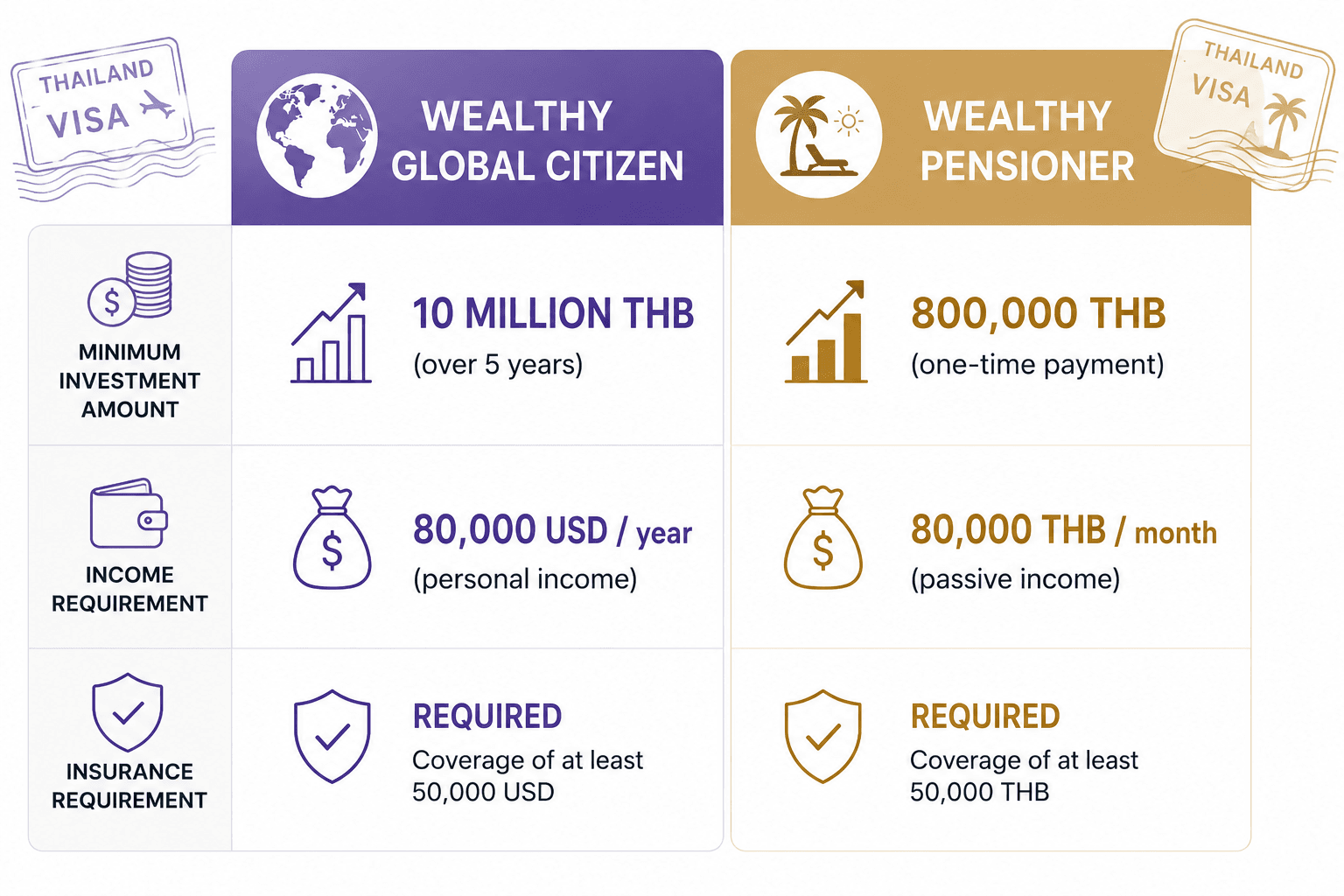
Two categories, two different property conditions:
| Criterion | Wealthy Global Citizen | Wealthy Pensioner |
|---|---|---|
| Property investment (or bonds/business) | Required — from $500,000 | Only if income is $40,000–80,000/year — from $250,000; not required above $80,000/year |
| Overall financial requirement | Total assets — from $1 million | Passive income — from $80,000/year (or from $40,000 plus investment) |
What the LTR visa is
The LTR is a long-term residency visa administered by Thailand's Board of Investment (BOI) through its own visa portal. There are four applicant categories in total, but a property investment as a way to qualify is relevant to two of them: Wealthy Global Citizen and Wealthy Pensioner. For the other two categories — highly-skilled professionals and remote workers for foreign companies — the property condition doesn't apply; those are tied to income and employment instead.
The Wealthy Global Citizen category
For this category, an investment in Thailand is a required condition, not an alternative:
The applicant additionally has to confirm total assets of at least USD 1 million (which can include the USD 500,000 investment above) and hold health insurance of at least USD 50,000 or maintain at least USD 100,000 in a Thai bank account for a minimum of 12 months.
The Wealthy Pensioner category
For applicants aged 50 and over with passive income, a property investment isn't mandatory — it's a fallback condition that only kicks in if income falls short:
The phrase "unearned or passive income" is worth noting — it explicitly excludes salary and earned income: what counts is pension income, rental income, realized capital gains, dividends, and interest.
The shared condition on property investment
Both categories share the same requirement: the property has to be registered in the applicant's own name, not a company's or a third party's, and the investment has to already be made by the time the visa application is filed — an application can't be built around a property purchase planned for later. If the property is jointly owned by more than one person, its value for visa purposes is split proportionally or equally between the owners.
Since the LTR visa is verifying a freehold property investment, for most applicants this means buying a condominium unit within the foreign ownership quota — it's freehold ownership registered in the applicant's own name that matches the requirement to "invest or hold ownership in their own name."
What to keep in mind before applying
The LTR visa application is a separate process from the property purchase itself and requires its own document package, submitted through the BOI's visa portal and reviewed by the relevant agencies — Immigration, the BOI, and the consular department. Before applying, it's worth making sure the documents confirming the money transfer for the purchase — an FET or Credit Advice — are correctly issued and accurately reflect the amount invested — that's what confirms the investment was made legally and with the applicant's own funds.
A gap between the declared investment amount and what actually shows up on the FET or Credit Advice isn't a technicality — the BOI can reject an application over exactly that kind of mismatch. That's why it's worth arranging the transfer for a purchase meant to support an LTR application well ahead of time and together with EXFM — with supporting documents issued correctly and matching the investment amount precisely.
Further reading: the official LTR visa criteria — on Thailand's Board of Investment portal ltr.boi.go.th.
Related articles

Buying Property in Thailand Through a Thai Company: Rules and Nominee Risks

Registering a Property Deal at Thailand's Land Department: What Happens on the Day

Due Diligence Before Buying Property in Thailand: What to Check and Why