Annual Property Tax in Thailand: Rates and the Fine Print for Foreign Owners
Buying property in Thailand doesn't end at registration — every year after, the owner pays land and building tax. Here are the rates, and the one detail in the exemption that gets more complicated for a foreign owner.
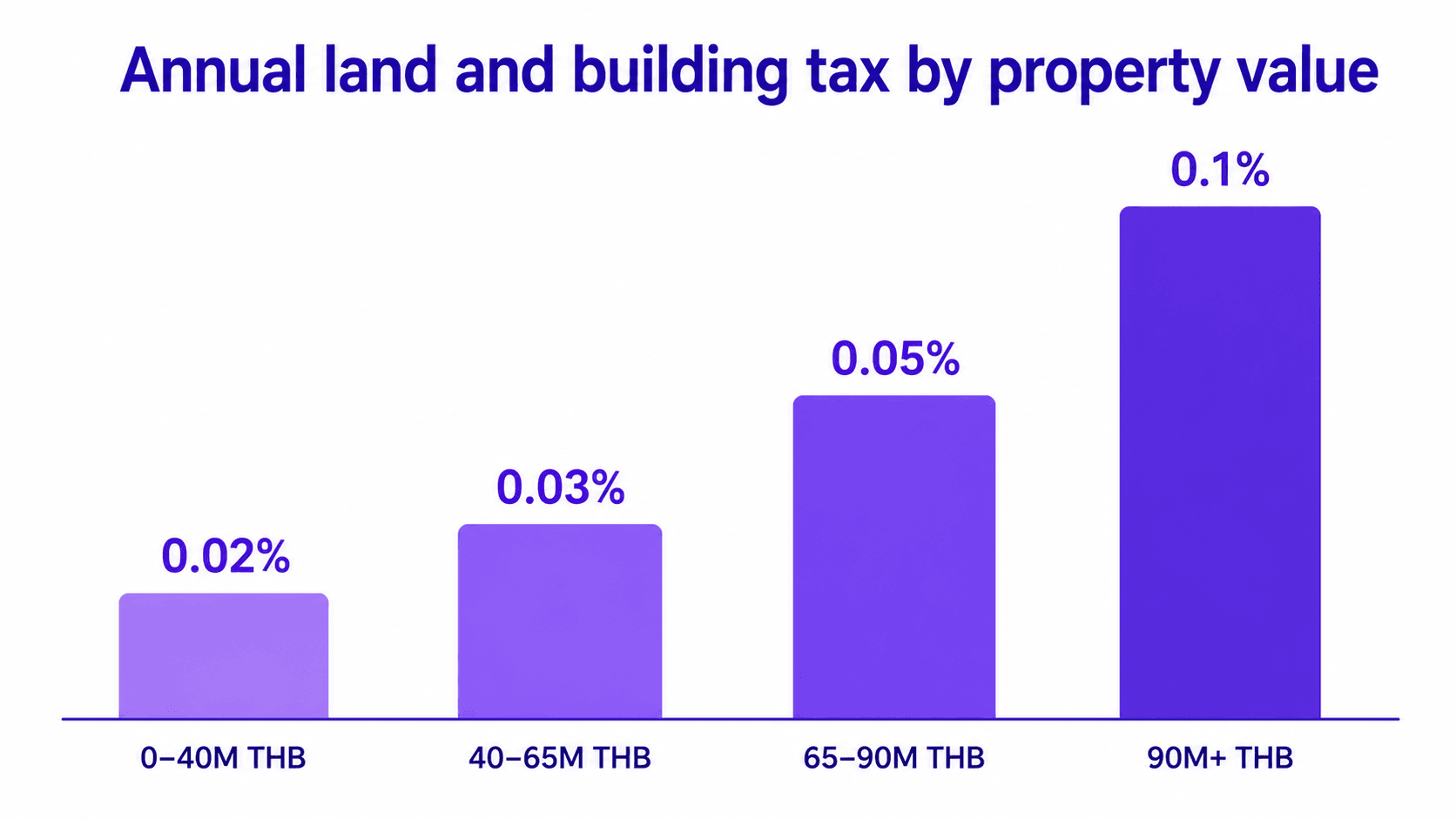
Before the fine print — here's the actual math. The rate depends on the property's appraised value:
Most condominium units in Phuket fall in the first bracket — here's what that works out to in cash terms:
The formula for a specific property (while its value stays under THB 40 million): appraised value × 0.02%. But before paying a single baht, it's worth checking whether the property qualifies for the first-THB-50-million exemption — covered next.
Who pays, and on what
Thailand's annual Land and Building Tax is paid by the property's owner, regardless of nationality. For a foreigner who's bought a condominium unit, the same principle applies as for a Thai owner:
The tax is calculated on the property's appraised value (not the purchase price) and is paid annually to the local authority where the property is located.
Rates for residential property
For residential property owned by an individual, the rates are progressive and rise with the appraised value:
If the value falls within the exemption threshold covered below, there may be no tax at all.
The first THB 50 million exemption: the catch for a foreign owner
A separate exemption removes the first THB 50 million of a residential property's appraised value from tax entirely — but the wording ties it directly to whether the owner's name is listed in the household registration book:
Here's the practical detail: the exemption, by its own wording, hinges on the owner's name being entered in the household registration book as their primary residence as of a set date. For Thai nationals, that's the standard (blue) house registration book. A foreign condominium owner can, in principle, be entered into a separate house registration book for foreigners (the so-called "yellow" Tabien Baan) — but only if they actually live in the unit permanently, hold a long-term visa, and are the registered owner. The process for this and the exact tax-exempt threshold can differ from the scenario where the exemption is calculated for someone who owns both the land and the building — a foreigner who owns only the condo unit, without the underlying land, typically falls under a different calculation. In practice, this means the exact exempt threshold and whether it applies to a specific unit is worth confirming directly with the local land tax office — the tessaban (municipal) or Tambon Administrative Organization (TAO) office where the property is located — before factoring the exemption into an ownership budget.
What happens if the property sits empty
A separate, steeper rate schedule under the Land and Building Tax law applies to property that isn't used as a residence and isn't rented out — vacant land and unused buildings in particular — with rates that climb faster than the residential schedule and increase further the longer the property sits idle. If a condo or villa isn't going to be owner-occupied or rented out, it's worth confirming with the local tax office in advance which category the specific property falls under — it can meaningfully change the annual tax bill.
Paying the tax itself, like paying for the purchase, may require transferring funds from abroad through a legal exchange channel — if it's more convenient to send the annual payment from abroad rather than pay locally, EXFM can help arrange that transfer and the baht conversion.
Further reading: the annual property tax rates in the original source — the thailand.go.th portal.